Polish

Churches everywhere walk a fine line on Easter Sunday. We're realistic and know that a lot of the people present on Easter Sunday will not be back for a year. So the temptation is to pull out all the stops on Sunday morning. The music is popping, the sermon is extra polished, the welcome team is extra friendly, and our people are dressed in their very best. We work hard for the extra level of excellence on Easter Sunday, because down deep (be honest) we think if we are extra polished on Easter Sunday, those once-a-yearers might come back. 

Maybe that's why they don't come back. 

Easter is a great chance to put hypocrisy on display. When we're over-polished for the sake of impressing people, we reinforce the stereotypes that keep them away the rest of the year. Most once-a-yearers think Christians are falsies who act differently on Sunday than we do the rest of the year. And let's be honest: if their experience is based on Easter Sunday, can you blame them? 

Obviously, Easter Sunday is the most significant holiday in the Christian calendar. We should celebrate. Easter Sunday should be special. We just have to be careful that we don't become hypocrites in the process. 

No Regrets

We had a great discussion this morning in a group I'm a part of about regrets. 

In 1 Corinthians 15:9, Paul remembers the dark time in his life, which could have caused him to be paralyzed by guilt and regret for the life he had lived. The very next paragraph in Paul's letter to the Corinthians is with regard to the resurrection. 

Because of the resurrection, Paul realized, we are no longer identified by our sin (1 Corinthians 15:17; 15:20). We don't have to live with regret and guilt, because the cross of Jesus Christ has paid that penalty. When we trust Him as Savior, He removes our guilt. We can live with no regrets. 

The other piece to that great news is that God will not waste the years you wasted. Because of Paul's experience as a Pharisee persecuting the Church, he had the platform to talk to a group many of us would not have been able to reach (Philippians 3:1-11). 

Many of you have pain from your past. But because Jesus has risen from the dead, you can live without regret, and make yourself available to Him to be used so that your past is not wasted. God has a way of redeeming our mistakes in such a way that He receives the ultimate glory. People who have been divorced often make great marriage counselors, when they make themselves available to God. Recovering addicts who are available for God to use them make the best sponsors and friends to people struggling through addiction. People who have wasted entire periods of their life can step in and help others who are headed down a similar path in a way I may not be able to. 

Because of the resurrection God can (and will) redeem your past if you make yourself available to Him. 

While Shepherds Watch Their Flocks

For Christmas, my father-in-law gave me the book "While Shepherds Watch Their Flocks," by Timothy S. Laniak. His church staff was reading it and he thought it might be something I would enjoy.

The book is a 40 day devotional, so I was fairly sure I wouldn't enjoy it. I never have been one for the daily devotional guide, because I tend to lose interest in the book long before the book comes to an end. Just a part of my personality.

But, my father-in-law is a good guy so I started into the book, more than anything so he and I could talk about it when we get together. I started it as a daily devotional, but got so excited about it I just decided to finish it (I'm not much for delayed gratification).

I don't think I'm over-exaggerating when I say this may be the best book I read all year.

I loved it. Not as a daily devotional book, but as a straight up book. It was really, really good.

Dr. Laniak spent his sabbatical from Gordon Conwell Theological Seminary living with shepherds in the middle-east, and wrote this book about his observations. Written mostly for those in Christian leadership, the book contains principles gleaned from shepherds that will help pastors, CEOs, and Sunday School teachers see leadership through a different lens.

This book is the 21st century equivalent of Phillip Keller's masterpiece on Psalm 23, though in some ways I would say it is even better. It contains just the right amounts of observation and application to be both informative and practical. The book is broken into three main sections: Provision, Protection, and Guidance - the three primary roles of a shepherd.

Please buy this book for your pastor. If you are a pastor, buy a copy for your elders and key staff. They will find it insightful, encouraging, and immensely helpful to their ministries.

Whew

If you haven't had a chance to look at some of the questions we received via text message on Sunday, look at the Living Hope blog. 

The text message experience was a great one, but I learned a couple of lessons:

1. Always have a back-up plan. The text messaging software we were using is web-based, and their server crashed about an hour before our first service. It didn't come back up until around 20 minutes before the service began, but our AV guys weren't sitting in a corner sucking their thumb. We were prepared for that kind of thing. 

2. You have to have someone screening the questions that wants to see the pastor succeed. Some of the questions we had come in were off topic, and obvious attempts to bait the "answerer" into a booby trap. I screened Ken's questions to make sure they were on-topic and answerable, without shielding him from the hard questions (question #1 was on Limited vs. Unlimited atonement). Unfortunately, I'm on the hot seat this weekend, and Ken is out of town. I'm not sure I trust anyone I can't pay back...

3. Promising to answer "all" the questions on a blog is not a good idea. We did that this week and when all is said and done I will have spent nearly 30 hours just answering questions. When you put something in writing, it needs to be abundantly clear and referenced because you can't get it back. So, I put a ton of work into answering about fifty questions, and that was way too much - especially when I have other responsibilities... like preaching on Sunday. This next week, I'll only promise to answer "a few" of the questions we don't get to in the service. If people don't get an answer in the service or on the blog, they can call me. 

All in all, this has been a really great experience for our church and a great exercise for me. I found I'm fairly good at coming up with answers to these questions, but need more work on remembering chapters and verses. "Somewhere in the Bible it says..." is not a sufficient answer! 

April 26th

If you live in the Dallas/Fort Worth area, you need to be at McKinney Church in Fort Worth on April 26th. I'm not trying to steal you from your church - you don't ever have to come back to McKinney after the 26th if you are plugged-in somewhere else; but if you can swing it you need to be here on April 26th. Plan to be at one of the two morning services, and at a lunch that will be provided afterward.  

Here's the catch: you're just going to have to trust me. 

For security reasons, I can't publish who will be here, or why it is so important for you to be here. You just need to trust me, and make plans to show up. And no, this isn't an April Fools joke. 

Curious? See you the 26th.  

BHAPs

If you've read anything by Jim Collins and Jerry Porras, (Building Your Company's Vision, Built to Last), you're familiar with "BHAGs." BHAG stands for "Big, Hairy, Audacious Goal," and it's Collins and Porras's contention that every organization needs them in order to succeed. 

I'm equally convinced that every person needs at least one BHAP - Big, Hairy, Audacious Prayer. 

What specific prayer are you praying these days that is so Big, Hairy and Audacious that if God doesn't show up it cannot be done? 

If you don't have one, you're missing a great opportunity to see God at work through your life in your world. You're also making a statement about the size of your God or the extent to which you truly believe He wants to work in the world. 

If you really believed Matthew 19:26, and Philippians 4:13, and John 14:13 were true (and I could go on and on), what big hairy audacious prayer would you be praying? 

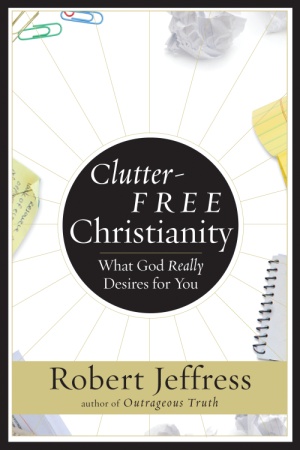
Clutter Free Christianity

Last week I read "Clutter Free Christianity" by Robert Jeffress. Jeffress is the pastor at First Baptist Church in Dallas, TX. I have only had the opportunity to meet Dr. Jeffress twice, and both times he was an extremely engaging, winsome, nice man. I know several people who attended the church he pastored prior to going to FBC Dallas, and say he is the quintessential pastor.

Clutter Free Christianity isn't a book on time management, or simplifying our lives, as the title first implied to me. Rather, it is a book designed to help Christians re-discover the things that are most important - "what God really wants from you - and what He wants to do for you."

Here are a couple of things I really liked about this book: Chapter 3 talks about "heart surgery," and contains a helpful reminder that the Christian life is not about behavior modification. We can self-help ourselves to spiritual death by making our external behavior the focus of our lives. Instead, the entire Christian life is about trusting God to carry out the work of transformation in our hearts.

Jeffress also has a helpful discussion about the reason we don't trust God. Basically, he says the decision to not trust God is a reflection of our unbelief that God has either the "character or the ability to fulfill His promises."

My big problem with Dr. Jeffress' book is that I don't feel as though Jeffress was as clear on the Gospel as he could have been. It starts on page 3, where he quotes Ephesians 2:8-9, and then writes "Those words are more than just an evangelical mantra; they are the bedrock of the Christian faith... However..." (emphasis mine).

You can't say "but" to something that is the "bedrock of the Christian faith."

The rest of the book is dedicated to helping believers understand what "God really wants from [us]," but in my opinion Dr. Jeffress makes that issue extraordinarily fuzzy. Dr. Jeffress claims the "essence of a right relationship with God [is] a heart fully devoted to Him and a heart that loves other people as much as we love ourselves" (pg. 4), and insinuates that if our lives don't reflect that we could be "surprised when [we] stand before God one day and hear His evaluation of [our lives]" (pg. 6). On the other hand he writes "To initially receive God's forgiveness by faith in God's grace and then revert to a system of good works to earn God's approval is like mixing oil and water" (pg. 38).

In my honest opinion, this book confuses the very issue it sets out to clarify.

By causing our "transformation" to be the implied grounds of our assurance of a relationship in Jesus Christ, I fear Dr. Jeffress' book will inevitably cause Christians to look in the wrong place for the Source of their security.

Let me put that a different way: When you trust that Jesus Christ paid your penalty on the cross, you have eternal life that is based solely on what He did (John 3:16, et al.). At the point you trust Christ, the Holy Spirit takes up residence and begins the work of conforming you to the image of Jesus Christ (1 Corinthians 3:16; Romans 8:9; Romans 8:29). That transformation often happens both internally and externally in the life of a believer, and at different paces for each individual.

However, when we look to our lives (or to the lives of others) as proof they are or are not believers, we look in the wrong place. No one has ever come to Christ by behaving better - so why would good behavior be the criteria we look at to decide where we, or someone else, stands with God?

Trying to figure out if someone has trusted Christ? Don't look at their lifestyle. Ask them.

Wondering if you are really "saved?" Don't look to see if you're behaving better these days. Ask yourself, "Have I trusted Jesus Christ alone as my Savior, Who paid for my sin on the cross and rose from the dead." The Pharisees behaved well, and they were whitewashed tombs.

Back to Dr. Jeffress' book: I don't remember the simple Gospel of eternal life through faith in Christ's death and resurrection alone being explicit a single time in the entire book. I have no doubt Dr. Jeffress believes it, and even preaches it, but it wasn't in this book. For a book on "Clutter-Free Christianity" to clutter the simplicity of the gospel and assurance in Christ alone is too bad.

Question?

This past week we started a new series at McKinney Church called "Living Hope." It's a series that answers several questions about Jesus, mostly from the book of 1 Peter. It's basic Christology, with a cool twist. 

We normally preach for 30 or 35 minutes, but for this series we're going to preach for 20-25 minutes and have a 10-15 minute question and answer session following the sermon. Because of our size, it isn't practical to open a mic for the Q&A, so we will be inviting people to send in their questions about the message via text message.

The idea isn't original to McKinney Church; several churches have tried this method with great success. It is a little bit of a stretch for us, mainly because it demands some extra personnel and technology (which is virtually never glitch-free). Even still, I'm pretty excited about the potential. 

I'm hoping the chance to interact with the message in real-time will cause people to move from passive to active listeners. Active listeners are more likely to be active appliers. 

We anticipate a pretty big response, and that we will be unable to answer all the questions in the main service. So, we've created a Living Hope Blog where I'll attempt to tackle most of the questions we can't get to in the service. 

Our Creative Arts Team has been working hard to make this thing possible. Seth and David do a great job, and most of it is behind the scenes. If you're a McKinneyite and see them, be sure to tell them "thanks." 

Depending on the response, my blogging over here might be a bit sporadic next week. Be sure to check the Living Hope Blog next week to see what we come up with. It should be an exciting week.

Gut Leadership

A lot of what I do as a young leader is instinctive. Sometimes an idea works, sometimes it doesn't. But I'm not always sure why I do what I do - there isn't a specific principle I'm working from, I just rely on my gut. The gut is a pretty important tool for a young leader. Sometimes you're able to feel things before you're able to explain them.
 
Of course, the gut can be dangerous, because it isn't always logical. You have to trust your gut, but never alone. The best young leaders I know surround themselves with more seasoned leaders, ask as many questions as they can (Proverbs 15:22), and take copious notes. They also pay attention to what they're doing, and make it their aim to never repeat mistakes. 

One of the responsibilities I feel as a young leader is to take good notes on the lessons I'm learning. In fact, that's the primary reason for this blog. As I go, and as the stakes get higher, I want to be able to better define my gut. The blog forces me to move leadership principles and lessons from my gut to my brain and out my fingers. It forces me to be logical, and helps me remember what I'm learning. I could keep a journal, but then I wouldn't worry about anyone else reading my thoughts, and I wouldn't be as careful. 

If you're reading my blog, you're helping me manage my gut. Thanks. 

Giving

There seems to be a lot of buzz out there right now about President Obama's tax plan, which could dramatically affect the amount of deductions a person could receive from charitable giving. Some of the people who wear tin-foil hats believe we're headed for a time in the very near future in which there is zero tax incentive for giving to churches and para-church ministries. 

Who knows? I may need to invest in one of those hats. 

Last week, I had a really good discussion with a couple of guys who asked if I was freaked out by the potential for such a plan. I'm a young pastor with a heart for the parachurch ministry as well. There is no doubt this plan would dramatically affect the budget of many ministries out there. 

But here's my honest opinion: That kind of plan would likely be awful for churches and parachurch ministries, but great for Christians. 

Make no mistake, it's a real blessing to be able to receive a tax break on charitable donations. But if that is the only reason (or even primary reason) Christians give, we might as well do away with it and start over from scratch.

We should give because (1) We're commanded to, (2) God loves a cheerful giver (2 Corinthians 9:7), (3) It demonstrates our dependence on God (Luke 6:38),  (4) it demonstrates that we know whose stuff we have (Psalm 24:1), and (5) it reflects a desire to invest in eternal things (Matthew 25:14-30).

If we're giving primarily so we can keep more of our money, we are at best teetering on the brink of idolatry, and the very best thing President Obama could do for Christians is to save us from ourselves. 

Restatement

I've mentioned before that one of my favorite people to listen to is Andy Stanley. Strictly from a communication standpoint, I can't think of many people in America that I would rather hear. I love his style, and his ability to communicate wisdom in a transferable, memorable way.

If you're looking for some good insight on leadership, Stanley's Leadership Podcast is a great resource.     

One of the things I love about Andy is that he seems to be absolutely unable to communicate a big point just once. Ever. He always restates his main point multiple times. I think it's compulsive for him.    

Last week I was listening to the Leadership Podcast at the gym, and Andy was giving a talk about communication to a group of several leaders. One of his main points about communication was that communicators need to be sure to always ask the question, "What do they need to know?" (And he repeated the question three times). 

He encouraged teachers to hone down their lesson to be able to answer this question in one sentence; this is the one thing, the big idea, the main point. Then he gave several examples of "main things" from sermons he had preached in the past. And as he said each one of those main points, he repeated them at least twice. And they were just illustrations. They were "main points" from the past - not even from this particular talk - but he was so disciplined in restating the point that he repeated them instinctively.    

As a leader, you know the main point. It oozes out of you. You've lived with it for 52 hours during the week. You've thought about it, you've created it, you've dreamed about it, you've tweaked it, and coddled it, and illustrated it, and applied it, and you could say it backwards and upside down.  And you will take it for granted that the audience will know it too, if you don't become like Pavlov's dog; every time you say the main point, say it twice. At least.    

Every time you say the main point, say it twice. At least.    

See how that works?   When you repeat a statement back-to-back you force your audience to focus on it. You attach little flashing red lights to the statement that let them know they need to remember it; that every thing in your message is tied to that point, and if they miss it, they'll miss the point. It gives them a chance to write it down, commit it to memory, or question whether or not it's really true. Once they've done that, you have them.    

Every time you say the main point, say it twice. At least. 

Madness!

If I were President Obama, my first item of business would be to declare today and tomorrow national holidays. What recession? What bailout? Iran has nuclear weapons? Who cares? March Madness starts today. 

These are, hands down, my favorite two days of the year. Beginning in 2 hours, 3 minutes, and 42 seconds, we will have nonstop college basketball for the better part of 4 days. 

I finalized my bracket this morning. We're doing a staff bracket contest together, so I can't tell you my final four until the games begin and the ability to change picks has passed - there are several cheaters on our staff who would love to peek over my shoulder to try to gain an advantage. 

Last year, I was narrowly edged out by the Canadian, whose method of picking is to go with the team who has the most cuddly mascot. 

It took me months to recover from being beat by a guy who waxes his eyebrows. 

But I'm back, better than ever, and ready to win it all. 

The way I see it, I've got about 2 hours worth of work left in me today. After that, I'll have to take a mental health day. If only "March Madness" was a legitimate excuse...

When I'm President, it will be. 

Corruption

Watching the news these days reminds me of something I heard Dr. John Hannah say during my time at Dallas Seminary: 

"Guys, corruption is stupid. Don't be a fool. You can get away with it for a while, but not forever. You can safely walk across the interstate wearing a blindfold too... once or twice."


Apply

One of the things I'm constantly thinking through is how to make my sermons stay on the forefront of peoples' minds throughout the week. This past week I preached about "All-in Availability" from Acts 28 where we saw Paul's example of availability to what God was doing through Paul's circumstances, and through Paul's communication. 

Obviously, one of my goals for that sermon is that people in the congregation would still be considering how to be "all-in available" on Wednesday and Thursday. That's an uphill battle. 

Sunday we tried to do something unique; to cast people out of their comfort zone and encourage them to respond in a physical way that isn't typical "McKinney." The goal wasn't to gauge a response, but to sear the commitment in our minds so that we couldn't forget before lunch. 

Reality: by lunchtime on Sunday, some of our friends had a chance to be all-in available in a specific situation, and they completely missed it. It's not their fault - they're just representative of a challenge we all face. We hear and see thousands of messages every day encouraging us to take action in a specific area; from following hard after Christ to changing the brand of toilet paper we use.  It is only natural that some of those get lost in the shuffle. 

So I have an assignment for you to comment on: Think back to a sermon that truly made an impact on your life; one that was still in your mind on Wednesday or Thursday. What was it about that message that was memorable for you? What helped it connect with you in such a unique way? 

Worship Venues

A fairly common trend in churches these days is to offer several different worship venues/services to allow people with different musical tastes to be in an environment where they feel comfortable. Churches like the Baptist church down the road offer a traditional service with choir, organ, and hymn books, followed by a contemporary service with a band, screens, and worship team. Other churches are even more specialized - they have a funk service, an alternative service, and an acoustic service. 

We currently have two services with a moderately contemporary feel - we'll never be confused as being "cutting edge," but we're not stuck in the seventies either.  I'm not saying our church will never go there but for right now, not having multiple worship venues is important to me. I like the discipline of it. 

On any given Sunday, there are two or three songs that I just don't like; only one or two that I do. At any church, not just ours. That's not abnormal. A "great" CD is one with 3 or 4 hits out of 10 songs - that's why iTunes is so popular.

Even when I served as a worship leader, there were only ever about two songs per service that I really connected with. I'm okay with that, because I've been around long enough to know that the songs that don't connect with me are meaningful to someone else, and help them respond to God more than my favorites. 

There is a selflessness involved in worship, and our music preference reinforces that. By creating many different music venues for a congregation, I worry that we're reinforcing selfishness and creating intentional disunity, which only serves to hamper spiritual maturity. 

A spiritually mature person doesn't worship better because of the style of music - he worships better because of what God is doing in his life.  


Illustrations

One of the real challenges for a teacher/preacher/communicator is finding illustrations that actually illustrate. 

My first sermon at McKinney Church included an illustration about me standing at the top of a high dive, trembling with fear. I told the story well, engaged the congregation well, and transitioned away from the illustration well, but the illustration failed miserably. 

How do I know? Everyone remembers the illustration; nobody remembers the point. 

If people remember the illustration but not the point, you have the relationship of the two backward: the point becomes the illustration and the illustration becomes the point. 

Confusing? That's the point... 

You want people to remember your point, and you want the illustration to help them do that. Sometimes stories are too good to tell. They're so good they distract from the point you're trying to make. 

A good illustration helps your point be more memorable. The best illustrations become forever connected with the point you were trying to make. For example: Ask any of the teenagers from my youth ministry years what they think of when they think of "crocodiles." I have forever ruined going to the zoo for them...

Storytelling is probably my biggest strength as a communicator, but is also the area that can crater my effectiveness more quickly than anything else because it so easily steals the focus from what I'm really trying to say.  

Organization

I'm not by nature an organized person. The people who work with me are always shocked when I tell them that, because I routinely keep my desk clear of clutter and excess piles. Even though I'm disorganized by nature, I can't function when my desk is messy. It's a nasty paradox that is just part of the burden of living as me...

Because I'm not an organized person, I don't even do good at organizing my organizational systems. I currently have a filing system for Bible Study, a filing system for meeting notes, and a filing system for articles. That is okay, until I get a magazine article in a staff meeting, and then I'm toast. I could streamline those filing systems, but that would take organization and I'm not by nature an organized person. Did I mention that already?
 
Enter: My two new best friends. 

About a month ago, the student ministry guys turned me on to Microsoft OneNote. I don't know which rock I was sleeping under when people started using this, but it has made my life a billion times easier. 

OneNote performs the functions of Word, Excel, and several other programs, and interfaces with Outlook, Power Point, and your web browser. It allows you to type, file, and copy information just like Word, but files your information in a notebook form. You can have as many notebooks as you want, and it will automatically file them for you according to grouping. Now I have a "work" notebook with separate sections for personnel, meetings, and general stuff. Within each of those sections I have separate tabs for various things pertaining to that section. 

If I had had OneNote during seminary, it would have saved me hours. Set it up with a microphone, start recording in OneNote, and take notes in a folder for whichever class you're in. When you go back to look at your notes, and realize you wrote down an incomplete quote, just click on the note and it will playback the recording at the exact point you took the note. That's sick. Just download the free trial and give it a whirl... trust me. 

Best Friend #2 is Windows Search 4.0. Since sometimes my disorganized style gets the best of me, I misplace documents, emails, and calendar appointments I need to find. Windows Search lets me do a quick search of my computer using keyword to find exactly what I'm looking for. 

Windows Search works in a similar way to Google Desktop, but will search OneNote files. Google Desktop will not, and I didn't want to hurt the feelings of Best Friend #1. Both Windows Search and Google Desktop are free, so you're not costing yourself any money for this convenience. There is no excuse not to have it.

One of my New Years Resolutions was to go paperless in 2009. Because of my two new best friends, I'm well on my way. I'm scanning in old files, and not adding any new paper files to my disorganized system. Now, they're all at my fingertips. 

Try it... you'll like it. 

Gray

A lot of my counseling opportunities come when people struggle with how to live in the gray. They need to make a decision in an area that doesn't deal with a moral issue, or a principle that is clear from Scripture, and those are difficult decisions. 

Unfortunately, those types of decisions make up the majority of the decisions we make. I've already made several decisions since I woke up this morning at 5am. Most of them were not black and white decisions. The Bible didn't tell me whether to wear a green shirt, orange shirt, blue shirt, or red shirt (I opted for green so I could wear orange tomorrow). Cheerios vs. toast was not a moral decision. I could have taken a couple of routes to work this morning, and wouldn't have sinned in taking any of those routes, but I chose one and didn't think much about it. 

Other decisions aren't quite so cut and dry. Should we participate in an activity where some people might do something immoral, although we ourselves will abstain? Should I exercise my freedom in a specific area, even though others might be offended?

Although the Bible doesn't give clear principles for every situation we face it does give clear principles for being wise in the gray issues, and especially the gray issues that could become black and white. 

In 1 Corinthians 2:2, Paul reminded the Corinthians that their entire focus should revolve around one thing: "Jesus Christ and Him crucified." Then he spends the entire book helping them understand what that looks like. 

They should be careful when they fight in church, because divisions can be a distraction from Jesus Christ and Him crucified (1 Corinthians 1-4). However, they should be quick to distance themselves from people who violate the black and white because those violations are a distraction from Jesus Christ and Him crucified (1 Corinthians 5), though their distance should be handled internally so as not to cause a distraction from Jesus Christ and Him crucified (1 Corinthians 6). The Corinthians were to have marriages that pointed to Jesus Christ and Him crucified (1 Corinthians 7), and should avoid engaging their freedom in such a way that would confuse the message of Jesus Christ and Him crucified (1 Corinthians 8-9), realizing from history that although everything might be permissible, "not everything is beneficial" for pointing to Jesus Christ and Him crucified (1 Corinthians 10). Instead, public and private worship (1 Corinthians 11-14) should always point to our hope of resurrection (1 Corinthians 15) which has been made possible because of Jesus Christ and Him crucified. 

How do you decide in the gray? A pretty simple (and scriptural) place to start is by asking the question, "Will this distract myself or someone else from the message of Jesus Christ and Him crucified?" 

Purim

Tonight at sundown, our Jewish friends will begin their celebration of the feast of Purim. Purim celebrates the time when God protected the Israelites from Haman's evil plot to kill them, recorded in the book of Esther. 

As a part of this feast, the Megillah (Book of Esther) will be read tonight in synagogues all across the country in what amounts to a really cool tradition that you should experience at some point. 

In most places, the book is read, or more literally sung, in a traditional chant which adds drama to the story. But unlike many Jewish feasts which are celebrated in a sober, respectful, reverent way, Purim is a big party. Many people write Haman's name on their feet, and as the story is read they stomp their feet and boo at every mention of his name. They cheer, yell, and use noise makers to participate in the story. They play pranks on each other, and spend a lot of time laughing - all to celebrate God's rescue of their nation from an evil plot.

When was the last time you threw a party as a reminder of what God has done in your life? When was the last time you got so excited you stomped your feet or cheered at the reading of God's Word? As a Christian who has been rescued from even greater peril than the peril posed by Haman, when was the last time you celebrated? 

Just wondering...


Shepherding a Child's Heart

I might as well get this over with... Sorry for the long review.

I picked up "Shepherding a Child's Heart" because my sister-in-law suggested I read it. Honestly, I hadn't ever heard of the book before. But this week, it seemed like everywhere I went someone was talking about it. I had a couple stop me in Panda Express on Monday who spent 15 minutes raving about the book. Some of our other friends have mentioned it in several different conversations, and all the reviews were extremely positive. A lot of parents feel like this book has really helped them.

Here are the things I love about this book: (1) It is the first parenting book I have read that emphasizes heart-change above simple behavior-modification strategies for parents. Our job is not to get our kids to behave, it is to point them toward Jesus. Tripp says "It is impossible to get from preoccupation with behavior to the gospel," (p. 67) and I think he's absolutely right. (2) Tripp does a good job of emphasizing communication with our children from a young age. We have to understand, and help them understand why they do the things they do.

With that said, there are a couple of things that I don't love about this book. The first one I talked about on Tuesday. Trip has a tendency to characterize many things as "unbiblical" that don't find a black-and-white basis in Scripture, and I find that extremely troubling. It helps him make a stronger point - everyone wants to raise kids in a biblical manner - but I don't believe a parent who grounds their child, or pushes them to make good grades a goal are living in direct violation of a clear biblical command. Tripp says they are.

The second thing is an even touchier subject (no pun intended). But, before I comment on Tripp's chapter on "the rod," I need to make a disclaimer:

I am not against spanking. If it were not for God's grace and some good spankings, I would be in the federal penitentiary today. There will no doubt be times in my son's life where he commits an offense for which the best discipline will be a spanking, and I intend to give it.

However. I do not believe "the rod" is the only God-ordained method for disciplining our child. Tripp makes a strong inference in that direction. In fact, he infers that if we want to be "biblical," we must follow the passages that talk about "the rod" in a strictly literal sense. "The rod" does not simply refer to "discipline," but to "spanking."

In fact, one of the most troubling parts of the book for me was an illustration Tripp used on pages 29-30 recalling conversations with his child:

"Father: Do you remember what God says Daddy must do if you disobey?
Child: Spank me?
Father: That's right. I must spank you. If I don't, then I would be disobeying God. You and I would both be wrong..."

In my view, that kind of conversation raises a whole host of problems. First, if a child is old enough to truly follow the logic of that conversation, he is probably too old to spank. Second, even Tripp admits there are some times you would overlook an offense (p. 111). If some offenses are okay for a parent to overlook, doesn't the above conversation give the impression to the child that you are sinning against God by not spanking him for every offense? Finally, God hasn't specified that we have to spank our child for every act of disobedience. He simply said, "the rod" will save them from death (Prov 23:13-14), demonstrate love for our child (Prov 13:23), and will bring us peace and delight (Prov 29:17). God never specifies which offenses deserve a spanking. He never specifies how many spankings a child is supposed to receive. And before long, that child is going to read his Bible and understand God didn't say Daddy needed to spank him for every offense, and feel as though God was being used as a scapegoat to justify punishment for something that may or may not have deserved it. That is a huge problem.

God has certainly been creative in the way He has disciplined me (Hebrews 12:7-11). Thankfully, He doesn't apply the rod every time, or for every offense. And I think it is okay (and not unbiblical) for parents to feel the freedom to follow His lead in being creative as we discipline our children.

Overall, there are parts of this book that I loved, and parts of the book that I strongly disliked. I can certainly see why so many parents are passionate about Tripp's book in a positive way, but think the book should be read (and recommended) carefully, because I believe some of Tripp's dogma is misplaced.