Someone you need to meet....

At seminary, much like at other institutions of higher learning, some courses stink; some courses are okay; some classes are good; and a very few classes change your life.

I've only had three classes that I would place in the last category without hesitation. The first was a class by Dr. Bill Lawrence called "The Spiritual Life." Basically, the class was an exposition of Romans 5-8, and I'll never be the same. He's now teaching some of the same material with an organization he founded called "Leadership Formation International."

The other two classes were both taught by Dr. Jay Quine. One was "The Gospels," and the other was "Old Testament Prophets." You've heard me talk about him before, but DTS just decided to run a profile of him on their main page. I've copied the text below, but you can find it here too. I particularly love the last paragraph, and the last sentence.


Dr. Jay Quine

Dr. Jay Quine’s purple socks give him away. He is not a typical professor, nor is he a typical lawyer. Born in Washington State, Dr. Quine married at the age of 21 and became a municipal court judge at the age of 24. He was a prosecutor, and is now a pastor, professor, and parent—and the discipline it took to become a lawyer and the faith he came to know personally in college have taught him to persevere through the toughest of trials.

A Rocky Start
After one year of marriage, Dr. Quine and his wife moved to Idaho to be close to the law school in which he was enrolled. “We lived on a wheat farm up in the foothills of the Rocky Mountains,” he says. The four-bedroom farmhouse had no television and barely any radio reception. No neighbors were in sight. “So it was just the two of us,” he says. “It was a really wonderful way to start a marriage.”

Twenty-seven years, five states, and two sets of twins later, Dr. Quine and his wife have come a long way from simple wheat farm living. Their twin boys, Preston and Skyler, are nine, and their twin girls, Madison and McKamie, are six. Their days are filled with everything from ballet and swim lessons, to basketball and baseball games.

So much activity, Dr. Quine admits with characteristic honesty, can strain a marriage. “You become more partners in a project than husband and wife. We just don’t get time together. We went to Israel this year as a couple without the kids and had two weeks together. It was just so wonderful to talk with my wife.”

But the joys of children outweigh the hectic schedule. He says his kids also keep him honest. “They will smell a fraud,” he says. “So [being a parent] forces you to be genuine, which is what we all need. You can’t just say you love them; you’ve got to love them. You forgive them. You accept them. You don’t hold grudges. You have to give of yourself all the time.”

One way he gives of himself is to read to his children. “When the boys were six I read through the Old Testament with them every single night. And I read from the New King James. Any question went,” including the inevitable question, “‘What does circumcision mean?’” he says. “Now I’ve decided to read the New Testament with the girls.”

Are You the Waiter?
Honesty is a valuable trait in a judge, but Dr. Quine’s foray into law began so early that no one believed he was one. At 24 he began working as a municipal court judge in Washington. “I was the youngest judge in the state,” he says. “I went to these judge conventions and I looked like the waiter. It was really funny.”

And Dr. Quine’s judicial practices were as unconventional as his age. “Fridays were traffic and small claims court. The people don’t have lawyers, so I’d come out and say, ‘One of you is going to lose and one of you is going to win. I’m not one of these guys who cuts the baby in half. You have ten minutes to see if you can resolve [your problem] without me, or the power of the law comes down on you.’ Then I would leave and come back,” he says. “Eighty percent of the time they would have figured it out.”

Although he loved practicing law and felt he was contributing to society, Dr. Quine was disturbed by a sense that he was “prostituting” his gifts. When the time came for him to petition for superior court judge, he and his wife decided instead to relocate to Dallas. He finished his Th.M. in three and a half years, something he attributes to learning how to read in law school. What are his secrets? “Focus, concentrate, know what to look for, know what to not look for, get past the fluff, zero in on the important stuff, highlight, take notes.”

From Dallas and Back
After taking all those notes Dr. Quine and his wife, moved to Lincoln Park, New Jersey, so that he could work as a singles pastor. Beginning with a small group of 17, it slowly began to grow. Soon, a few single musicians began to attend and with Quine formed a band called Just Three Things. Before they knew it the singles group was steadily increasing in attendance and the band was touring up and down the East Coast. They played venues that varied from spots in Manhattan to the rooftop of Patterson Prison. “It was absolutely incredible work,” Dr. Quine says of working with the singles group and seeing the band take shape. “So many people came to Christ because of it.”

After four years Dr. Quine went to pastor another church in central New Jersey. “They wanted to grow and build, so we started a building project seven months later.” While he was helping the church to expand, Dr. Quine was also expanding his horizons. He began teaching at Philadelphia Biblical University (PBU) and eventually became the chairman of the Bible program. Nearly three years later he was spearheading the effort to create a Master of Divinity program from scratch.

Because of that involvement, he and his wife moved their family to Yardley, Pennsylvania, to be closer to the campus. And because he’s also a pastor at heart, Dr. Quine took over pastoral roles at a little church two blocks from their new home. “We lived this idyllic life,” he says. His children walked to school and to church and could ride their bikes everywhere. The draw to Texas again was all in the timing. With the Master of Divinity program up and running at PBU, Dr. Quine felt led to return to full-time teaching at Dallas Seminary. And although the transition has been as tough as law school, he still says that “everyday is an amazing day in our house.”

And each day he earns the respect of his colleagues such as Dr. Thomas Constable, chair and senior professor of Bible Exposition. “Dr. Quine combines excellent scholarship with many years of effective pastoral and academic experience,” Dr. Constable says. “He understands well how the Scriptures bear on the situations our students and graduates face in ministry.”

He understands because he has been in each situation—whether he’s behind a judge’s bench, a podium, a pulpit, or a dinner table. And in every situation he seems to know what the music group’s name indicated: just three things matter in life—faith, hope, and love (1 Cor. 13:13). So when he is behind a dinner table with his family, Dr. Quine will occasionally raise his glass to signal the family’s traditional toast: “Jesus is coming back!” they chorus and clink glasses. What does that mean for a father who has worn everything from a judge’s robe to a professor’s purple socks? Well, in the words of one of his children: “It means the mosquitoes won’t sting anymore.”

Farewell to an Old Friend

Well, this morning I said "farewell" to an old friend. No, nobody died. Nobody moved away. Relatives, don't worry... Kari and I are still on good terms. But the separation anxiety I feel today is almost as intense as a death, departure, or divorce.

Yesterday was my last day of Summer vacation, ever.

I thought Summer and me had bid our goodbyes once before, in 2002 when I graduated from Oklahoma State University and moved to Dallas to work full-time while attending Dallas Seminary.

But I became reacquainted with my old friend when we decided to move to Plano last year so that I could serve at Fellowship Bible Church North and ramp-up my class load. I had forgotten how much I missed him.

It's a good thing though. Nine months from now, I'll be a seminary graduate - armed and dangerous. I'll have to work a "real job" at "real hours" for "real money," and summer vacation and I won't be able to be friends any more.

I'm sure gonna miss that guy.

If it wasn't for the sad goodbye to my friend summer vacation, today would be a great day. I love the first day of the fall semester at DTS because the campus is flooded with a new class of first-year students pursuing their dream of a Masters-level education in theology and the Bible. Many of them have stories you wouldn't believe, and are making sacrifices to be here that would give you a lump in your throat.

Too many seminary students lose that dream somewhere around third semester Greek, and it's a shame. Somewhere along the way too many of us learn to argue but forget how to love others. We learn how to be right but forget how to serve. We learn to be accurate but forget how to apply. And we learn how to write but forget how to dream. We begin to serve the god of knowledge above the God of the Bible.

There's hope on the campus today. Today I see a few hundred students with desire, passion, intensity, and a genuine love for Christ who haven't yet learned to forget that seminary can be an unbelievable extension of our worship, if we let it.

Starbucks Sabatoge

Top secret menu items at Starbucks? Sabatoge in the supermarket? Check out this article from the BBC.

http://news.bbc.co.uk/2/hi/business/5274352.stm

This just proves what we've all known for some time: Starbucks is a covert operation run by Satan attempting to bust the budget of millions of pastors who have no place better to meet.

(Thanks to Seth Godin for the link)

Female Sunday School Teacher Fired

Check out this story on CNN. Apparently, the First Baptist Church of Watertown, NY has a little media crisis on their hands.

I've said for a long time that one of these days I'm going to write a book of stories including some of the things I've experienced in ministry in just my short number of years serving full-time as a pastor. I've hesitated to begin the manuscript because nobody would believe it. But the more I read the news, the more I realize there are some pretty crazy things that happen in churches.

To make a long story short, the Watertown FBC sent Mary Lambert a letter in the mail from the pastor's wife telling her she would no longer be allowed to teach her Sunday School class based on 1 Timothy 1:43, "I do not permit a woman to teach or to have authority over a man; she must be silent." She's now gone to local and national news sources with her story.

There are so many things wrong with this story that it's not even funny. Here are the top three:

1. The deacons/elders/pastors at this church handled the situation very poorly. Even if the lady is an old bag, you owe her the honor of a face-to-face conversation prior to a letter delivered by the postal carrier. The issue for me isn't the application of 1 Timothy 1:43, but the failure to apply wisdom in their delivery. It's one thing to deliver truth and another thing to do it with love. If the deacons/elders/pastors had elected to have the hard conversation with this lady, and to do it in love, the issue never gets wings.

2. A lot has been said against the pastor and elders in this situation, but this "sweet elderly lady" certainly isn't innocent. Surely after teaching Sunday School for 54 years she ran across a passage or two concerning how to deal with disputes inside the church. 1 Corinthians 6 comes to mind, Matthew 18... In every case, the dispute is to be handled within the church, not in the court of public opinion. When this lady called her local news to gripe, she demonstrated spiritual immaturity that should disqualify her from teaching even if her gender does not.

3. The pastor is also a city council member. That always makes me cringe. For one, I'm not sure how he finds time to shepherd his flock and lead a city at the same time. My golf game would take a serious boost from that type of ministry schedule. Additionally, I'm not sure the best place for clergy is in dictating public polity. I'm all for Christians in secular politics, don't get me wrong, but can't imagine how it would be a great thing for paid clergy to occupy those positions. I'm not worried about his Christianity infiltrating his politics, but have serious doubts about whether or not he would be able to keep his politics out of the pulpit. And that's a problem.

The Church is supposed to be salt and light in the world. That would be a lot easier if we stopped doing stupid things.

Dog Days

This is the most excruciating couple of weeks in the whole summer. It's hot in Texas (I can't remember the last time the high temperature dipped below triple-digits). I also can't remember the last time it rained.

It's a little too early to get excited about the Major League Baseball playoff hunt, and my Texas Rangers are well entrenched in their customary late-summer choke anyway. The countdown clock I've been using to gauge the time until the college football begins is below two weeks now, but watching it is like watching grass grow.

Meanwhile, the majority of the ministries at the church are ramping up toward kickoff but aren't there yet. Summer classes are over, and the Fall Session doesn't begin until the last week of August. Although this is officially my last summer ever as a full-time student, I'm ready to get cranking again.

These are truly the dog days of Summer.

The Type-A voice inside of me hates this time of year. (Admit it - you hear those voices too). I'm a visionary guy who loves to create. I love to strategize, plan, implement, and be active in the development of new things. And I'm addicted to the adrenaline rush that's attached to coming up with a new idea, implementing it, and watching it work. So these two weeks to me are like quitting crack cold-turkey.

But I also find that my Type-A voice doesn't do a very good job of governing my levels of emotional, physical, and spiritual health. Picture him as the cheerleader dressed in red sitting on my left shoulder shoulder screaming, "Go! Go! Go!"

I've got another cheerleader on my left shoulder who doesn't get much attention. She's the cheerleader sitting on my right shoulder screaming, "Rest! Rest! Rest!" I don't listen to her very often because, frankly, her constant nagging gets bothersome. How am I supposed to create, plan, and strategize with all of her screaming on my shoulder?

The Dog Days of summer let the "Rest!" cheerleader have her way. And it's probably a good thing.

I used to have a choir director who had a great philosophy I've tried to adopt. He would constantly tell us, "Let's practice hard now, have our crisis early, and we'll coast into the concert." That's wise advice.

So, I'm thinking of these two weeks as having my "crisis" early. I'm recharging, taking advantage of the chance to read some things I've been wanting to read, and trying to catch up on some of the projects I've been wanting to do.

This way, I get to rest on my own terms. If I listen to the "Go!" cheerleader for too long, I'll end up resting on someone else's terms after I've sacrificed my physical, emotional, or spiritual health, and I don't want to go there.

For today, picture me as the cheerleader on the right. "Rest!" Kick back. Read a good book. Reconnect with your family. Watch the Little League World Series. And have your crisis now. September will be here before we know it.

Oops...

Quick. What do the JonBenet Ramsay murder and the demise of the Oklahoma University football program have in common?

Stumped? I'll show you.

In case you've been lounging around under a rock for the past few days, you know that a man has confessed to the murder of JonBenet that took place almost exactly ten years ago. Although there are some serious questions as to whether John Mark Karr actually murdered JonBenet, or just needed a way to bust out of Thailand's prison system, the self-professed pedophile is being extradited to the U.S. for further questioning.

Karr's confession included these words "I was with JonBenet when she died. It's very important for me that everyone knows that I love her very much and that her death was a mistake."

Let's shift gears to the other situation, a situation you might not know about, Oklahoma University has been embroiled in a controversy that has seen its start quarterback kicked off the team after receiving thousands of dollars from a car dealership. Rhett Bomar, a star quarterback from Grand Prairie, TX was on the payroll of the car dealership but rarely, if ever, clocked in. While you're not going to see me crying about the demise of Zero-U football, I did find Bomar's press conference following his dismissal from the team extremely interesting. "I'm not a bad kid. I made a mistake and I'm disappointed that it happened that way, because I enjoyed my time at O.U. and I wanted to continue my career there. I made a mistake and I have live with it."

What do the JonBenet Ramsay murder and the demise of the Oklahoma University football program have in common? In both cases, the alleged perpetrators claim the crime was committed by mistake.

Those aren't mistakes. Boneheaded? Yes. But not mistakes.

I made a mistake when I typed "shift" above and missed the "f" with my finger (Thank God for spell check). My sister-in-law made a mistake when she forgot to fill up her car with gas before heading home from our house last week (Now everyone knows, Sara). You make a mistake when you're swinging for a fastball and the pitcher throws a curveball.

Duct taping a six-year-old while you strangle her with a cord is not a mistake. It's premeditated, heinous, first-degree murder.

Taking paychecks from a car dealership where you don't work is not a mistake. It's also premeditated, a violation of known rules, dishonest and selfish.

Somewhere over the past several years, we've lost the ability to call evil what it is. Particularly when we're at fault. We talk about "mistakes," "accidents," "mishaps," and "inadvertent errors," but we've lost the ability to look our evil in the eye and call it what it is. And what suffers as a result?

Grace.

Think about it: rightly or wrongly, we expect forgiveness for mistakes. That's why we call them mistakes. Mistakes happen. Everyone makes mistakes. This could have happened to anyone. Mistakes deny ownership of the thing that has been done, blaming it instead on chance or bad luck. "I'm not a bad kid," says the former Oklahoma University quarterback."

Wrong Rhett. You are a bad kid. And so am I. And so is everyone else who will read this blog entry. You know what they say, "the first step is admitting you have a problem." And failing to understand that we have the problem - we are the problem - prevents us from understanding the depths of God's grace.

When I think that Christ died for my mistakes/accidents, I'm non-plussed. But to think that He paid for my evil... I don't deserve that.

You Can't Handle the Truth

I had lunch today with Jack Warren, the Executive Pastor at Fellowship. Among other things, his duties include developing and implementing strategy to help the church reach it's goal, and overseeing staff.

Jack's an extremely relational individual, and self-proclaimedly borders on ADD. We have a lot in common.

The topic of conversation was sweet-spots. If you're not familiar with the terminology, picture a golf club. Although you can advance the ball by hitting it anywhere on the club face of your nine-iron, the club was designed to produce maximum effectiveness when hit in a specific place: the sweet spot.

The theory is that all of us have sweet spots as well. We can each do life and ministry a lot of different ways. From a human standpoint we could participate in many activities and "advance the ball." But we've each been designed with a specific gift-mix and certain abilities to allow us to be maximumly effective in certain areas.

My sweet spot seems to be preaching. Jack's is helping staff members and others through the really tough situations in ministry. Often that includes hard conversations and difficult decisions, sometimes in which a staff member needs to be reassigned or terminated. Jack thrives in those situations.

I don't.

How can you be highly relational and still enjoy those conversations? Most of the people I've known in the best who were direct and confident in hard conversations were not the type of people you'd play golf with. But Jack is. And for the life of me I couldn't figure out how he balanced the two.

So I asked him.

What he said is worth repeating. He said, "Chris, when you're highly relational and analytical, you realize that the hard conversations are often the very best way to love a person, and they're almost always best for the overall health of the church. What it comes down to is this: people crave someone who will tell them the truth. I see it as a privilege to be able to be honest with people that I care about, even when that honesty means a little discomfort for me on the front end. If we aren't willing to tell them the truth, who will?"

Unbelievable...

If you didn't believe it before, here is conclusive evidence that some people will believe absolutely anything.

The First Church of Tiger Woods is up and running. Actually it's been around for several years, but just came across my radar.

Is this a joke? Not really. The self-proclaimed "pastor" of the church has an article on the site called "what is this really all about?" He's serious about his disillusionment with the Christian Church, a disbelief in the Bible, and his agnostic view of God. But if God does exist, Tiger Woods is probably him.

Even if the site contains a large amount of hyperbole, and it does, the sentiment is still sad. Check it out for yourself. Don't miss the comparisons between Jesus and Tiger. And while you're reading the site, consider this: Does the Church bear any responsibility for websites like this? Obviously they're the result of fallen human people behaving as such, but is there something else there?

I'm convinced that if the Church did its job of truly worshipping God for Who He is, the rest of the world would be scared to death to make such off-the-cuff jokes about Him.

Quote Me

"[ours is the age of simulation] For just as shopping malls simulate the great outdoors, replacing sun and trees with fluorescent lights and green plastic "plants," we simulate danger with amusement park rides, friends or enemies with talk-radio hosts, rebellion with torn jeans and black boots, sex with lewd phone conversations, revolution with improved fabric softeners, and freedom with the newest panty liner. We simulate real life by eliminating risk and commitment, and end up mistaking what is real for what is only artificial. We exist, that is, encased in a giant cultural condom.”

- Joey Earl Horstman

Edit: I've received two or three emails from people saying that they don't get the quote. One said, "I think I'm not a deep enough thinker. It could be that I can't get past the panty liners and condoms!"

It could be. It could be that you have to understand the context of the quote. It's in a chapter about the way we as a culture relate to God and others.

The idea is that most people don't know how to relate to others or to God any more because we've grown accustomed to a life of simulation. Nothing's real - everything's virtual reality. We're so used to things being fake that we don't notice when they are. Amusement park rides aren't really dangerous. Neither are talk-show hosts our "buddies." But we call in to their shows and pretend they are. Panty liners don't give girls true freedom, but the commercials on TV advertise that they do.

As a result, we're mixed up, and living lives that are sheltered from reality. We'd rather simulate real relationships with God and others because "real" relations are dangerous. (Hence the condom metaphor).

Subtleties

I just finished a summer class this morning that attempted to present a theology of worship. Much of the required reading for the course was by modern theologians with an ultra-traditional bent towards things. In contrast, the majority of my summer reading has been books by people with an ultra-contemporary bent towards theology and the church.

The experience of reading ultra-traditional theologians back-to-back with ultra-contemporary theologians has been something like taking a cold shower after you run. The initial shock is almost unbearable, but ultimately you even out somewhere in the middle and are thankful for the event once you've recovered from the shock.

I've noticed something about the authors I've been reading that is subtle, but awfully telling about the great divide that exists in theological (and church) circles today.

(As a side note, I realize the terms "traditional" and "contemporary" are loaded to the hilt with baggage, but chose them because they're decidedly less loaded with baggage than the others I could have chosen)

The majority of the authors I've read with a more traditional bent tend to write of the second Person of the Trinity as "Christ." They emphasize the "Life of Christ," the "Words of Christ," and the "Person of Christ" among other things. For the most part, what they say about "Christ" is accurate and biblical.

On the other hand, many of the authors I've read with a more contemporary flavor to their theology tend to emphasize the second Person of the Trinity as "Jesus." They emphasize "Loving Jesus," "Coming to Jesus," and "Believing in Jesus." Like their traditional counterparts, many of the things they say about "Jesus" are accurate and biblical.

What's the difference? Emphasis.

I told you it was subtle.

The term "Christ" typically points to the Deity of the second Person of the Trinity. It is a title that means "anointed," and usually speaks of His exalted state above the Universe as a unique Person of the Godhead.

The name "Jesus" is exactly that: Jesus' name. It's the name the second Person of the Trinity was called by Mary and Joseph when He was born a Man. Most clearly, the name "Jesus" reminds us of Jesus' humanity.

Is it right to call the second Person of the Trinity "Jesus?" Sure. Is it okay to call Him "Christ?" Sure. The writers of Scripture use both.

So what's in a name? More than you might think. The names and titles people use to refer to the second Person of the Trinity are awfully telling. Many of the ultra-traditional theologians emphasize Christ's deity to the detriment of His humanity. As a result, they present a "Christ" who is impersonal, cold, uncaring, and surreal. In contrast, many of the ultra-contemporary theologians emphasize the humanity of "Jesus" to the detriment of His deity. In their books, we find a personal, forgiving, "Jesus-is-my-homeboy" man, but miss His holiness, perfection, and complete sovereignty.

Both extremes are a tragedy. Jesus Christ is 100% God, and 100% man. Talking about Him as anything less is blasphemy and idolatry. It's hard to balance the two. It's impossible to understand the two.

It's a tricky business to accurately picture the Person of Jesus Christ with our words, thoughts, and ideas. But we must take great care to not speak less of Jesus Christ than is true of Him... even in the subtleties.

Proximity

My boss/mentor/friend Drew Leaver has a post today about the importance of proximity in leadership. It's certainly worth reading.

Back in July, Tony Morgan posted a top-ten list of reasons he was glad his friend Tim Stevens was blogging. I don't have a top ten list for Drew, but his blog is certainly worth checking out. Drew has a way of putting things profoundly and succinctly at the same time and will be a great blogger. I'm excited to be able to point you his way.

Look Ma, I'm Famous!

I'd like to take this moment to thank my mom for not naming me Keisha, Jamal, or Deshawn. If she had, the national weather service wouldn't be able to bestow the honor on me that I'm currently receiving. (At least, that's what one of my state representatives said a few years ago)

As tropical storm "Chris" sets his sights on the Caribbean en route to the United States, my name is being heard on newscasts all over the world. I'd like to thank all the little people who made this honor possible.

People keep telling me that there's no way this storm is actually named after me - after all, there were four kids named "Chris" in my third grade class. If it were named after me, they say, it would be "Chris F.," the name by which everyone from my childhood knew me. Have you ever noticed that in your moment of glory, people seem to line up to shoot you down?

So what am I doing now that I'm famous? Well, mostly sitting by the phone waiting for Pat Robertson to call. The 700 club will surely want to interview me about God's latest display of wrath. That's good, I've got some stuff I want to tell them.

Meanwhile, since today is the first day of the month, I get to start a new book of the Bible on my devotional plan. Last month was Lamentations, and I'm sure glad to move on. Sure, Lamentations was good. There were some good surprises throughout the month - like discovering that the book is about hope more than it is about lamentation.

If you count how many times the book refers to God's promises either directly or indirectly, you see that Jeremiah (I'm assuming he wrote the book) was convinced that even the current situation - as awful as it was - was a reflection of God's faithfulness to His promises. And throughout the book you see hope shining through that God's faithfulness in judgment was evidence that He would be faithful in restoring His people.

But beyond that, Lamentations was a whipping for me. So I'm excited to move on.

If you're taking the devotional plan journey with me, you should know that I'm going to depart from my plan this month. I've had some recent thoughts about the Sermon on the Mount, and am going to spend this month in it instead of going to 1 Peter. I'll get back on track with 1 Kings in September.

That's all for now. Watch for my namesake on television tonight, and stay tuned for updates on exactly when I'll appear on the 700 club. I'm thinking about growing a mullet so I fit in with some of the previous guests.

One Hundred B'rakhot

How did you do? Refer to last Thursday's post if you aren't sure what the assignment was.

And if you haven't already, give it a shot tomorrow - consider this a challenge.

If you attempted the excercise and listed 100 things for which you can say "blessed are You God," my guess is that you found it a little harder than you anticipated. I sure did.

It bothered me that it was so difficult - I generally think of myself as a pretty thankful person. I work hard to come at God with more than just my requests and gripes, and to be thankful for the things He's done for me. But when I try to list 100 of the things for which I can give God praise, I had a hard time.

The day started with me running late for a 7:00 o'clock meeting. As I drove through the drive-thru of our neighborhood Starbucks, I wrote on my pad "B'rakhot #1 - Thanks for the coffee." Then the Starbucks lady came to the window and handed me my cup. "Thanks for the coffee," I said.

For some reason, the fact that I said the same thing to the coffee lady that I said to God troubled me. I think that's a good thing, because it put the whole excercise of saying 100 b'rakhot in an entirely new light. The 100 b'rakhot isn't just about being thankful. It's about being thankful, but it isn't just about being thankful.

The idea of the whole excercise is to see the things that reflect God's attributes and character in the world around us - not just the stuff that God gives us.

It's hard to break out of the 10-year-old-at-Christmas mentality. You know what I mean - we say "thank you" to your parents for the gifts, but it's often rushed and insincere. After all, parents are supposed to give gifts at Christmas, aren't they? Gifts had shown up under the tree for years, so we grew to expect that they'd be there again. We were thankful, yes, but were never "awestruck" by the fact that our parents continued to give us gifts even though we really didn't deserve them.

The 100 B'rakhot excercise reminds us to be awestruck at what God does for us on a regular basis. It reminds us that even the most minute things reflect the character and attributes of the Creator God. From the minds that created the technology and innovation that make my alarm clock work every morning, to the fossil fuels that power my commute to work and school every day - God created them all. The wildflowers that spring up along the median of a metropolitan freeway reflect the creative nature of an infinite God, and the value He places on beauty and excellence. The smile of a 2-year old covered with donut crumbs reminds us of the hope God gives for tomorrow, and the wrinkled smile of a ninety-year-old bedridden saint (also covered in donut crumbs) reminds us of the hope God gives for eternity.

Blessed are You Lord, (Baruch atah Adonai), Maker of heaven and Earth, for You have done great things.

Challenge For Tomorrow:

One of the books I'm reading this Summer is titled A Royal "Waste"of Time - The Splendor of Worshiping God and Being Church for the World, by Dr. Marva J. Dawn.

It's a wonderfully interesting discussion of the theology of worship. I say "wonderfully interesting" not because I agree with Dr. Dawn on everything - we end up on opposite sides when we answer several of the questions she asks. But, the questions themselves scratch some itches I've had for a long time. They're thought provoking, and challenge many of the ideas that threaten to derail worship from the way God originally intended it. It's a good read.

Dr. Dawn starts several of the chapters with sermons she's given at various lectureships and churches where she's been invited to speak. One of those sermons struck a chord with me, and challenged me to try something. I wanted to post the idea here before I give it a go. That way, I can take several of you down with me when it's harder than it seems.

The following is an excerpt that can be found on page 219 of Dawn's book, in a sermon entitled "One Hundred B'rakhot."

The habit that I want us to consider this morning is the Jewish practice of trying to say at least 100 B'rakhot a day. That word B'rakhot is the plural form of the noun B'rakha; as I mentioned earlier, it comes from the verb at the beginning of the Hebrew prayer, "Blessed are you" or "Baruch atah." Can you imagine what it would be like if you tried at least 100 times a day to say sentences like these: "Blessed are you, O Lord our God, King of the universe, that you have created men and women with intelligent minds who have invented alarm clocks so that I woke up on time this morning"; "Blessed are you, O Lord our God, King of the universe, that you have caused the sun to shine and the rain to fall so that the fruits of the harvest could be made into this breakfast cereal"? How might this change our attitudes?

What the Jews sought - and still seek - to accomplish by saying 100 B'rakhot a day was to find Joy in every aspect of life because of their sense that God is behind it all. Since we eat packaged food, and live in packaged houses, and have plenty of appliances and conveniences, it's quite easy to forget that God is the source of everything. The value of saying a B'rakhot is that we keep remembering that God is King of the universe after all, and therefore He's in control of all that happens. And because he is, everything will be quite all right.

So who's with me? Pick a day this weekend and see how close to 100 you can get. Write them down and report back on Monday. The gauntlet has been tossed down. Let's see how you do.

All Wet...

Henderson Hills Baptist Church is notorious for many reasons, the most notable being that two years ago on Monday they served as the hosts to a pretty infamous wedding party: mine.

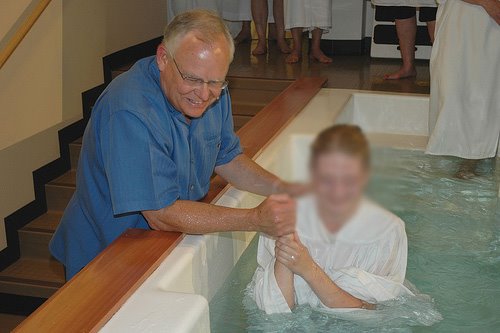
But more recently, the church is entrenched in a controversy regarding baptism and church membership. Several weeks ago, the elders of the church put a proposal before the congregation requesting a bylaws change. If approved, water baptism will no longer be a requirement for membership at Henderson Hills.

Although the elders presented the proposal, senior pastor Dennis Newkirk is taking the brunt of the criticism from local and national Southern Baptists. And if the old boxing rule "he who loses his cool first loses" holds true, the critics of Henderson Hills lost this debate in the first round. They're mad. In fact, the Baptist Messenger (The Oklahoma Southern Baptist's periodical) has dedicated an entire issue to a campaign against Henderson Hills' proposed bylaw change. Add that to some search-and-destroy missiles from the blogosphere and about all that's left is vulture food.

Both arguments are arguments from silence. The Scripture doesn't explicitly link or separate water baptism and local church membership. The Southern Baptists argue that church history has linked baptism and membership from the days of the Church Fathers. True, but the church has linked a lot of other things throughout history that we're not so proud of. In fact, if we want to go there, for a good part of church history, a person was baptized in a corner room of the church so that they could be baptized completely nude. They weren't dunked backwards, but went straight down into the water with the pastor's hands on their head. If we want to point to church history to validate our arguments, let's go whole hog.

History - even hundreds of years of history is not a source of Truth. Yes, we should tread softly when it comes to rethinking ideas that have been held for hundreds of years, but the argument "we've always done it this way," does not carry water. We have to deal with the Text, and if we can't prove a belief from the Text, we must tread even more softly.

Where Scripture is silent, we have the freedom to act wisely. When we encounter an issue for which there is not an explicit principle or command in Scripture, it is perfectly acceptable to make decisions using the wisdom God gave us. That's why we have wisdom in the first place.

But when we make wise decisions about issues not covered by a principle or command in Scripture and then apply those decisions as laws for others to follow, we start to opperate in sketchy territory. In fact, over the years we've developed a term for that kind of behavior: legalism. Remember the Pharisees? They were well-meaning guys who wanted to be so Scripturally accurate that they started making their applications of the Law into laws themselves.

Now, don't miss my point... the Pharisees of Jesus' day missed God altogether. I'm not saying the critics of Henderson Hills are the same way. What I am saying is that it's entirely possible to become so convinced of our extra-biblical decisions that we impose them on everyone else. Although we don't have Jesus' words on baptism and local church membership, we do have His words on making our own decisions into laws for others, and it isn't pretty.

Should local churches require new believers to be baptized by immersion prior to being accepted as members of the local church? Scripture doesn't say.

I, for one, find it hard to believe that we should require more to be a member of the local church than God requires for membership in the Universal Church. I find it hard to believe that the physically handicapped or gravely ill should not be allowed to be members of the local church. I find it hard to believe that we would refuse membership to an immature Christian who believes that his "sprinkling" identified him with the death and resurrection of Christ just as my immersion did, although we'll let immature believers with other nasty habits and beliefs in... so long as they've been baptized. That doesn't make sense to me.

But, if your local church wants to make water baptism a membership requirement, I think Scripture gives you that freedom. If your church wants to make the completion of a membership training class a requirement for membership, go for it. If you want to catechize new believers before you admit them to membership, more power to you. But don't throw rocks at the first church who disagrees with you.

I grew up Southern Baptist, and served on the staff of a Southern Baptist Church for several years. I'm proud of my heritage as a Southern Baptist - a denomination who has been on the right side of theological issues more often than it's been wrong. But it has been wrong before. And if the SBC, on the local, state, or national level, decides to remove Henderson Hills from its fellowship for making a decision on an issue not explicitly covered in Scripture, it will be the wrong decision.

There are many theological issues and interpretations worth dividing over. An issue that has no basis in Scripture, either positively or negatively is not one of them.

One More Israel Picture


Sorry the formatting of my last post came out so weird. I tried to fix it once, and made it worse. Now I'm to the point where I've been messing with it for so long I'm ready to just be done with it. It won't win any layout awards, but I'm done caring.

This was the last picture I wanted to include for now (I have 347 more you haven't seen, but you'll have to buy me dinner if you want to see the rest).

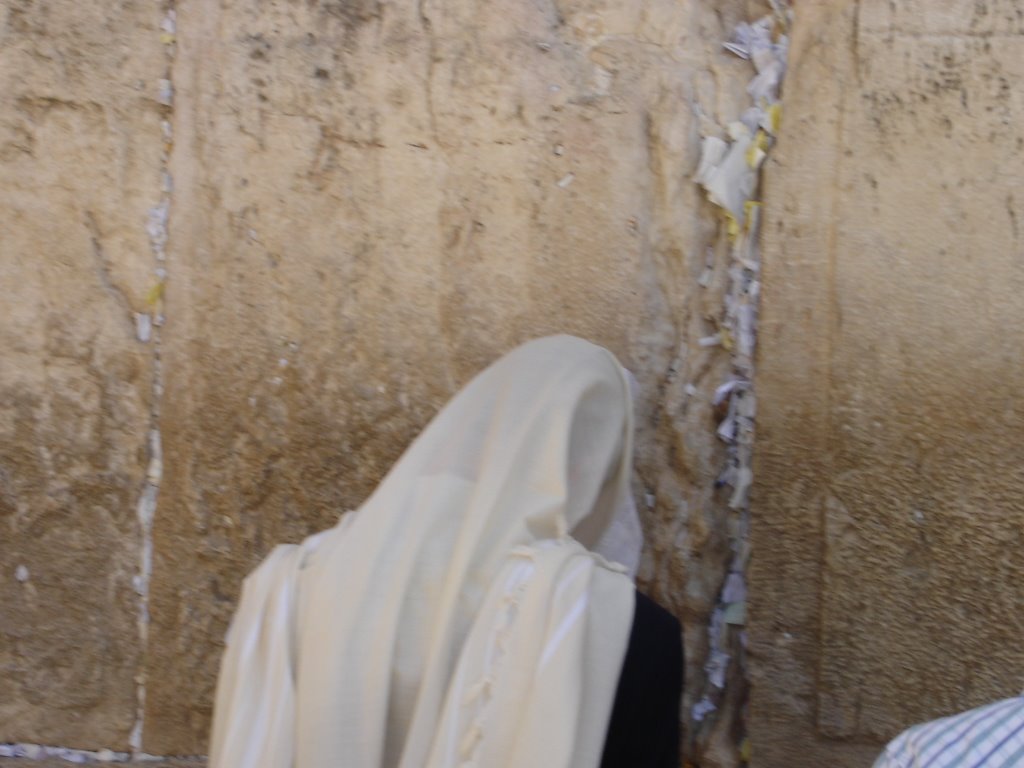
This is an Israeli soldier praying at the wailing wall in Jerusalem. It seemed strangely appropriate today.

Israel photos.

Well, if you push enough buttons, you're liable to fix something. I've been working for the past several weeks to get some pictures posted from our trip to Israel. Somehow today it's working. So...

Here's my favorite picture of the trip. If you've ever had anything to do with Gene Getz, you'll know he's the most humble man alive. But did you know he was humble enough to smear Dead Sea mud all over himself and pose for 50 pictures? He did.


This is the Mt. of Beatitudes, taken from the Sea of Galilee. The Sea of Galilee was Kari's favorite place on the trip. It remains relatively untouched by modern civilization. Only one city, Tiberius, can be seen on its banks, which gives the view a very authentic feel. One evening while we were there it got very windy, and the waves got pretty big. I could sympathize with the disciples - I would have been pretty nervous if someone had come walking to me on the water.


The Treasury Building at Petra. No, they didn't really keep money there. It was a burial cave for a king. And before you ask, yes I looked inside - I didn't see the Holy Grail.


This is me with my angel in the shepherds fields with Bethlehem in the background. I tried to get her to sing something angelic, but she was afraid she'd scare the sheep.


That's all for now. I had one more picture I wanted to post, but for some reason the upload isn't working again. So, I'll be happy for what I got uploaded, and post the other one when blogger commits.

Wow.

I'm working on figuring out how to post some of our pictures from our trip to Israel, and am having a hard time. Add that to the fact that I'm extraordinarily busy with some writing deadlines and haven't been able to post in a while.

While I'm waiting for life to calm down, you have to check this guy out. Make sure and watch the whole routine.

Over the river and through the woods...

Kari and I leave Saturday for two weeks in Israel. It's a trip we've been looking forward to for nearly six months. We'll be traveling with Gene Getz, the Pastor Emeritus here at Fellowship, and a couple of families from the Dallas area. It's truly the opportunity of a lifetime.

We were worried for some time that my health wasn't going to allow us to go, but God has been good and answered our prayers. Our prayer all along has been that God would heal me miraculously - to the point that even our doctors were amazed. Last Friday, my doctor bragged and bragged about the progress I've made, "beyond what I could have asked or imagined." Those are his words, not mine. Seems like I've read those words before...

We're excited to walk in the dust of a land that has thousands of years of history. We'll walk in the storied field where David had his showdown with Goliath. We'll stand on the mountain where Elijah asked the prophets of Baal whether their god might be too busy in the john to answer their prayers, and we'll walk through the Garden of Gethsemane. I've heard I'll never read my Bible the same way again, and certainly hope that's true. We couldn't be more excited.

My mom and grandmother, on the other hand, couldn't be less enthused. I keep trying to persuade them that it's okay - if something goes down in Israel it's only a local flight to heaven. Somehow they don't share my perspective.

While you're pining away in the absence of a blog, look for me on this wailing wall webcam. I'll try not to make a fool of myself, but we'll be there one day. If you know me, you know I'll be the guy wearing orange.

Shalom.

I don't know where I am!

Airports are the best places to meet some of the most interesting people on the planet. I always enjoy trips that require me to fly because I'm always surprised by something (or someone) that I see. It's a ripoff if you ask me - a hundred years ago people only had to pay a nickel to watch a freak show. Today you have to buy a plane ticket. Stupid inflation.

Last weekeend, Kari and I flew to Charleston, South Carolina to visit my baby brother. At the time we booked our flights, there was no direct flight to Charleston from Dallas, so I got to enjoy people watching at 3 of America's finest airports. With the exception of one lady who didn't seem to realize she was breast feeding her baby in the middle of a teeming mass of people, and two teenage girls traveling alone who reminded me why we are never having daughters, I was fairly disappointed with the number of weird things I saw in Dallas, Charlotte, and Charleston. It certainly wasn't worth the $1000 freak show ticket.

I did, however, have one rather sad encounter with a lady at the gate for our flight out of Charlotte.

A very pretty old lady, probably in her nineties, was wheeled to the gate by a sky cap, and promptly left by herself. The sky cap didn't give her further instructions or even a "thank you." She just wheeled the lady to the gate and left her. In hindsight, I think the sky cap probably realized she wouldn't be getting a tip from this elderly lady, and was ready to move to someone who would be a little more gratuitous.

Obviously confused, the elderly lady started looking around. Panicked, she looked at me and exclaimed "I don't know where I am."

I was tongue-tied. I didn't want to give her too much information, thus insulting her ("You're in a wheelchair honey."), but I didn't want to give her too little information and leave her still confused ("You're on the planet earth. Time to come back"). So, I opted for the middle-ground. "We're in Charlotte, North Carolina ma'am."

"No," she said, "I know where I am. I don't know where I'm going."

I persuaded her to show me her boarding pass so we could figure it out, and recognized that she was headed to Charleston, South Carolina on the same flight I was waiting for.

"No," she said again, "I know where I'm going. I just don't know how to get there."

With the help of another passenger who recognized the lady from an earlier flight, we got this poor woman calmed down and on the flight to Charleston where she was to attend the weddings of two of her grandsons.

Now, I realize that this poor woman was probably dealing with some senility issues coupled with the pressure of being in crowded airports all day. But as I sat down on the plane, I realized how common her quandry was to all of us. No, we're not often stranded and confused in airports, but don't we ask the same questions every day? Aren't the three statements she articulated the three things that cause uncertainty in our own lives?

Where am I? Where am I going? How am I going to get there?

Those questions are so simple, and yet they're at the heart of almost every dilemma we face today. In some sense, our spiritual life, occupational life, family life, and every other aspect of our lives demand that we consider each of these questions.

Try it out. Think about a decision you have to make today. See if it can't be answered by considering the answers to the 3 questions the woman in the Charlotte airport posed at me. You might be amazed.

You know what they say... "Out of the mouth of senile old women..."