Not in school...

Monday's post was with regards to the debate about Intelligent Design, and the Flying Spaghetti Monster theory. Although the theory was meant in jest, it does an apt job at pointing out the ludicrous ends to which the tolerance argument can lead. If we allow the tolerance argument to go to its logical end, society finds itself with an obligation to teach kids about the Flying Spaghetti Monster in the same breath they teach kids about the Almighty Creator of the Universe. It may not surprise you, but I'm not comfortable with that.

It may surprise you however that I am also not comfortable with the concept of Intelligent Design being taught in public schools. Of course, I don't think they should teach Darwin's theory of evolution in public schools either, as it is a theory that has been abandoned by honest science long ago. Unfortunately, since science doesn't have an alternate answer to either Darwinism or Intelligent design, it has allowed the public school system to continue teaching a system that hasn't been honestly accepted for years. Why was it abandoned? Because Darwinism doesn't answer the question it sought to answer; it only pushes the question back a billion or so years. What did the first organism to evolve look like and what did it evolve from? Even a simple-cell organism had to come from something. And Darwin doesn't explain it.

But that's another post.

The public school's job is not to explain to my kids how the universe was created. That's my job as a parent. (I don't have kids right now, so I guess I should say that will be my job). From the very beginning of humanity, it has been the responsibility of the family unity to teach children truth about God - not the school system. Deuteronomy 6:4-9, the "Purpose" that "drove" Israel, commands fathers to teach their sons about God, not teachers.

I was blessed to have many wonderful teachers during my elementary, junior high, and high school years. Many of those wonderful women were also believers. But their responsibility was to teach me how to read, write, do math, and how to survive in a capitalistic society. My parents' job was to teach me truth about God.

I don't want my kids learning truth about God from their public school teacher who may or may not be a believer. That isn't why I will send them to school. It's my responsibility, my job, my privilege.

I hope the Kansas School Board decides not to force teachers to teach intelligent design. Maybe that will force some of the parents who want pawn their responsibility to someone else to get to work.

Intelligent Pasta

Well, today is my first day as an unemployed pastor. (No fear Mom, it's only until I start my new ministry next Monday, but send money if you want).

I could get used to this house-husband thing. I actually caught Sportscenter this morning for the first time in a couple of years. I sent my wife off to work so we could eat tonight, and played with the dog for an hour. Now I'm leisurely catching up on my email and blogsurfing. Life is good. Of course, when my wife gets home from work and finds the house is a mess, the dog has eaten her shoes, and I'm still sitting in front of the computer in my boxers where she left me, there will be some 'splainin to do. But for now, I'm living the high life.

I ran across this link this morning in the newspaper. http://www.venganza.org/

Apparently someone has decided to mix my two favorite pastimes: the pursuit of Truth, and the love of food. Unfortunately, the result is worse than three-day old road kill.

The Flying Spaghetti Monster is one guy's addition to the Intelligent Design debate. Bobby Henderson created the idea in response to a Kansas School Board debating on whether or not to include a discussion of Intelligent Design in their science curriculum. Henderson wondered if the school board allowed discussions of ID, whether it would be a distinctly Christian intelligent design that was taught, or if other faiths (such as the followers of the Flying Spaghetti Monster) might be given attention as well. What began as a joke has snowballed into a group of people who call themselves "Pastafarians," and give credence to my philosophy that some people really will believe anything.

I don't think there are really people do homage to the Flying Spaghetti Monster theory of creation(although my obsessive love for The New Yorker Pizza and Pasta Restaraunt in Arlington may be evidence to the contrary); or that the decrease in pirates is the real cause for global warming, something this site also claims. But unfortunately, the point Henderson makes is representative of a mindset our society holds. Whether it's the God of the Universe, or the Flying Spaghetti Monster, the tolerance culture believes each deserve equal time and respect in our schools and society.

When it's time to change...

Peter Brady sang it best on the Brady Bunch... "When it's time to change, you have to rearrange, who you are into what you want to be." Although the occasion of my song is not the same as his (my voice hasn't cracked like that since tenth grade), the point is well taken.

Kari and I announced to the Elders of our church several weeks ago that this coming Sunday would be the last Sunday at our church. We've taken a position in Plano, TX at Fellowship Bible Church North. I'll be working under the Adult Ministries Pastor in the areas of small groups and leadership development.

Although leaving a ministry is never easy, Kari and I are extremely excited about this opportunity. My long-term vision for ministry is to be involved in the training of non-staff church leadership, to help them lead the church more effectively. We often recognize men as Elders or Deacons in our church because of their skill in the secular workplace. We assume men who have effectively led banks or other businesses will be apt leaders within the church. In many ways, we're right. The organizational skills, communication skills, and visionary skills that are needed to effectively run a business can be put to good use within the leadership of the church. However, the church is a Body, not a business. It's a fellowship, not a firm. And there are distinct differences between leading a church and leading in a corporation.

Fellowship Bible Church North sponsors the Center for Church Based Training, which exists in part for this purpose. Their philosophies can be found in a book called "The Leadership Baton," which is co-written by three representatives of this organization.

I'll write more about the book, and about Fellowship Bible Church North in the future. Meanwhile, I have an office full of books that aren't going to pack themselves.

Weirdo

My post yesterday about Inclusivism sparked a couple of personal conversations via Instant Messenger with teenagers who were present at our Bible Study Sunday Night. (That's right - Instant Messenger. We're cutting edge down here). During one of those conversations, I was lamenting the vastness of the church's task in the future based on the changes in logic that the current culture is attempting to make acceptable. You know, the logic where yellow can be blue to you as long as you don't argue with someone else who says it's red?

At one point in the conversation, I mentioned that I thought this type of thinking was the single most important thing preventing the modern generation from embracing Christ as their Savior. The student with whom I was conversing disagreed.

"No, Chris. We don't embrace Christ because Christians are weird," he said.

Today, I'm at the seminary all day. And after observing the guys and girls walking around this campus, I'm afraid my friend was right. We are weird.

The guy sitting on my left in the computer lab has fourteen earrings in his left ear, give or take a couple. He's cooler than me, (I think he's Emerging), so I'm trying not to get caught looking at him. The tattoo on his ankle says "Servant" in Greek. It's too bad he couldn't have tattooed the entire luw paradigm on his ankle - at least that would have come in handy during a quiz.

The opposite end of the spectrum just walked in. He's carrying a stack of books a mile high, that are obviously just for effect (What class would require a paper where you would use BDAG, a commentary on Ecclesiastes, one of Howard Hendricks' books, and a Hebrew Bible among other things?). He's wearing a suit, and has the perfect evangelical combover. His glasses, I swear, are the same glasses that Chuck Swindoll wears now. He makes the rounds around the computer lab shaking hands with everyone, punctuating the silence with a huge belly laugh like he's heard Swindoll do a thousand times.

My friend was right. Christians are weird.

When the Bible alludes to the fact that this world is not our home, I don't think the application is that we should live like we're from another planet.

A real danger of living in the holy huddle is that we forget what real people are like. We forget how to start conversation with something other than "what's God doing in your life?" We don't know how to talk about life, or our faith without theological word-dropping. We aren't real. We aren't human. We're weird.

I think much of the answer lies in the fact that Americans feel the need to look to someone or something else in order to form their identity. We model our speech patterns, our dress, our habits after others we like, who are doing influential things. If Michael Jordan wears the shoes, we want to wear the shoes. If Britney Spears is wearing it, stores can't keep it on the shelves. If Will Ferrel or Napolean Dynamite says something funny, we want to say it too. We're obsessed with being someone else.

The Church is doing the same thing, only worse. Where I live, in Arlington, Texas, every church in town has had Forty Days of Purpose. What's the purpose? To be a huge church with lots of money the way Rick Warren did it. Because if Rick Warren's doing it, we want to do it too. We all want our small groups ministries to look like Willow Creek's, because they're cool and we want to be too. And if Charles Swindoll tells a good story on the radio Tuesday afternoon, three thousand pastors across America start scrambling to change their sermons so they can use the illustration Sunday and be as great a communicator as Chuck.

We're obsessed with fitting the "cool mold." But we haven't figured out that it's only cool when someone else does it. Elvis impersonators are never as cool as Elvis. They're just creepy.

Most of us learned in Sunday School as kids that God created us just the way we are. As we've grown up, our Sunday School teachers' words were proven right by the test of Scripture. Ephesians, 1 Corinthians, Galatians, and other books go to great lengths to describe who we are in Christ, and the gifts God has give us so that we can be uniquely used by God in His work on earth. (Operative word: uniquely).

We hear sermons all the time from 1 Corinthians 12, about how the hand shouldn't gripe because it didn't get to be the eye, or how the ear is not more important than the big toe. And those sermons are packed full of illustrations about how the janitor shouldn't harbor resentment against God because he didn't get the gifts to be the pastor. Pastors couldn't preach in dirty churches, we're told, so both are important. And those illustrations are accurate, needed, and applicable in today's society.

But when was the last time someone reminded us that the left hand shouldn't gripe because it isn't the right hand? Or that the big toe shouldn't gripe because it isn't the left toe?

Isn't that exactly what we're doing when we try to model everything God has given us after someone else? We're terrified of being unique. We're scared to death of having our own responsibility and our own sphere of influence. We don't want to be the left hand, because John MacArthur's the right hand, and he's doing such a good job we don't see ourself as useful. So we try to be more like him.

If you're right handed, have you ever tried to write with your left hand? You can do it. And people can read it. But that isn't the task your left hand was intended for, and your writing is awkward... weird... at best. But that's what we do when we decide that the gifts, talents, abilities, and ideas that God has given us aren't as good as the ones he's given to someone else. We limp along trying to use someone else's gifts and talents to make us seem more effective. In reality, it just makes us look weird.

Stump The Chump

Sunday Night is "Red Pill" night at the church where I'm a Pastor of Students. Red Pill is a Bible Study named after the blockbuster The Matrix, in which a red pill stands for truth. Recently, the Bible Study has been led by students who are instructed to teach a Scripture passage that they are attempting to live out in their own life. It's been a very effective opportunity for the teenagers, many of whom are actually excited about the application of God's Word. It's weird; the whole thing has become like a huge game of charades, where teenagers start living out specific passages of Scripture weeks before their "lesson" and try to get other teenagers to guess what passage they'll be talking about.

Yesterday morning I got word that my speaker wouldn't be showing up. Her soccer team made the finals of some tournament, and her assistance was needed on defense. So the lesson fell to me.

Of course I've been doing my best to study and apply Scripture in my own life, but that's what I teach about all the time. I needed something different. So my wife recommended we play a game I like to call "Stump the Chump." Basically, it's a free-for-all, where the teenagers are given permission to ask the hardest questions they can think of about the Bible or life, and I give the best answer I can. After my answer, I get either thumbs-up if I answered the question adequately, or I get the buzzer if I didn't answer the question adequately. It sounds cheesy, but the kids love it, and the benefit is two-fold. First, I get a glimpse into what they're really thinking about. Secondly, through their use of the buzzer, I figure out pretty quickly how well I am articulating what God's Word says.

Frankly, it wouldn't be hard to stump this chump. I'm a glutton for punishment when it comes to this game, but fortunately I've played it a couple of times before and tend to be able to anticipate the questions they'll ask. (By the way, I've always promised them if I don't know the answer to a question, I'll admit it, and then buy them dinner for coming up with such a perceptive question. And it's happened before).

Last night, at first, was no different from usual. I got the usual barrage of "Why do bad things happen to good people?" "How far is too far to go on a date?" "Could God make a burrito so hot that not even He could eat it?"

But then the questions moved into a new area. About four of the forty or so kids present started pelting me with similar questions. They all started centering around the inclusivist debate. You know... "If God is really loving, how could He let my Muslim friend go to Hell?" And, "Is Jesus really the only way to God?" (I found out later that one of the main questioners had recently converted to Islam with his family). As the time wore on, the questions started getting more and more intense, and my answers were getting "buzzed" faster than flies in a bug zapper.
Some (not all) of the teenagers at this Bible study weren't buying it.

I explained to them that all religions couldn't be true; that Christianity believes there is one God, Hinduism believes there are more than nine-hundred gods, Mormonism believes you can become a god, and certain forms of Buddhism believe there is no God. Those ideas are contradictory, and therefore cannot all be true. Then I pointed to one of the kids and took the question further. "If I say Matt is wearing a yellow shirt, and you say Matt is wearing a blue shirt, we can't both be right. Either he's wearing a yellow shirt and I'm right, he's wearing a blue shirt and you're right, or he's wearing a different color and we're both wrong. Those are the only options. We can't both be right."

Four hands shot up at the same time. I called on one of them.

"Sure you can," he said, "The shirt is yellow to you, and blue to me. Just because you see it differently doesn't make me wrong."

The remaining three hands went down. "He took our point" they said.

I'm not a person who is normally left speechless. But last night, I had nothing to say. The chump had been stumped, but not with a question that was too hard to answer. The chump had been stumped by the sheer lunacy of the junk with which our kids are being brainwashed. I felt like I was talking to four brainwashed zombies rather than the well-dressed, all-American teenagers I was talking to.

Today's culture is presenting the church with some major obstacles to combat in the coming years. They disguise themselves as intellectual pursuits, but intellectual responses aren't accepted as answers. There's a different mindset in the minds of our youth, and it's terrifying. Blue isn't yellow, black isn't white, and truth is not relative. And the concept of absolute truth needs to constantly be reinforced by the church who believes in truth from an Almighty God, absolutely.

Was Hurricane Katrina a Demonstration of God's Wrath?

An organization called "Repent America" has taken the opportunity to step into the limelight after Hurricane Katrina ravaged New Orleans and Mississippi, claiming that Katrina was God's judgment on a "wicked city."

If you can stomach it, read the entire press release here.

"Although the loss of lives is deeply saddening, this act of God destroyed a wicked city," stated Repent America director Michael Marcavage... "We must help and pray for those ravaged by this disaster, but let us not forget that the citizens of New Orleans tolerated and welcomed the wickedness in their city for so long," Marcavage said. "May this act of God cause us all to think about what we tolerate in our city limits, and bring us trembling before the throne of Almighty God," Marcavage concluded. "[God] sendeth rain on the just and on the unjust." (Matthew 5:45)

It saddens me when groups like this volunteer to speak on behalf of the entire Christian community. But it sickens me when groups like this volunteer to speak on behalf of God Himself, especially while in the same breath mangling what God really has said.

Who gave Repent America the authority to speak on behalf of God? Who told him that this horrible event was a result of the "Southern Decadence Festival," a party catering to homosexuals that was to be held in New Orleans this week? Even if it were, why did the hurricane wipe out other parts of Louisiana and Mississippi? I suppose that's where Marcavage's quotation of Matthew 5:45 comes into play.

Unfortunately for Marcavage, Matthew 5:45 seems to make the opposite point. Jesus' comment in the Sermon on the Mount was spoken in the context of His instruction to love others, even the unlovely. When Jesus mentioned rain in this context, he wasn't speaking of it in a torrential, tragic, judgmental sense, but in the sense of a blessing. In an agrarian culture, rain was seen as a blessing from God (just as sunshine, which is also mentioned in this passage, but not quoted by Marcavage), not a curse. Just as God bestows a certain amount of blessing on the entire earth, of which sun and rain are examples, followers of Christ should not show partiality in their love of others.

What do we say of Katrina? Why did Katrina ravage New Orleans and leave it in complete and utter shambles? Because it was a hurricane. That's what hurricanes do.

Why did Mount Pinatubo erupt in the Phillipines in 1991 killing more than 800 people? Because it's a volcano. That's what volcanoes do. If they didn't erupt, they wouldn't be volcanos.

I'm not saying God doesn't have control over nature. He surely does. But we shouldn't look at every natural disaster as evidence of God's wrath against a culture any more than we look at sunny days as evidence of God's acceptance of a culture.

To claim inside knowledge of God's ultimate reason for every event that takes place on this earth is presumptious. Job was one of the most righteous men to ever live, and he didn't know why disaster after disaster came into his life. Furthermore, as we look back on the story we recognize that it was not because of God's judgment of Job, but because of God's pleasure with Job that He allowed Job to be tested.

God's thoughts are not our thoughts (Isaiah 55:8-9). Although we as Christians would like to be able to give an answer for everything we do not understand, that is not our responsibility. Why did God allow this horrific tragedy to happen? Maybe we'll understand someday. For now, it's not our responsibility to speak concerning God's purposes where God's Word has not given us that privilege or responsibility.

The "Others" Are Winning.

A few weeks ago, I posted some comments about the Air Force Academy, and the room marked "other" in their historic chapel. This week, an article published by the Associated Press appeared in the Dallas Morning News. It appears the "others" are beginning to make their voices heard.

Read the complete article here.

In short, it seems non-evangelical Christians are making some noise about an evangelical bias held by the United States Air Froce Academy. If the irony of a mainstream media article griping about a right wing bias is not enough to make steam come out your ears, the spin the article puts on the situation at the USAFA will.

According to the article, the perception of some cadets at the USAFA is that "evangelical Christians wield so much influence at the Air Force Academy in Colorado Springs that anti-Semitism and other forms of religious harassment have become pervasive."

Seriously? Anti-semitism?

Anti-semitism is a word that has become hip to use again. But it's used as a word designed to garner an emotional response without regard to the original intent of the word. Anti-Semites are those who are against Jewish people. Are we really to believe that this kind of attitude is pervasive (their word) at the USAFA?

If it is, it isn't a problem with evangelical Christianity. It's a problem with discipline at the United States Air Force Academy. Taking away privileges from evangelical Christians will not change the mindset of sick individuals who hold an opinion contrary to mainstream evangelical Christianity.

The issue of relgious "tolerance" is out of control in today's society. The fact that I hold an opinion contrary to yours and have the freedom to say so is one of the freedoms that the cadets of the United States Air Force Academy have pledged to fight for. Tolerance of religion is one thing. Acceptance is another. To forbid "sectarian" prayers (prayers in Jesus' name) is to deny the rights and privileges of every American to speak his or her mind.

So a Muslim is offended by my prayer in Jesus' name. Sorry. I'm offended by his request that I pray to someone or something else. I wouldn't ask him to pray in Jesus' name - he isn't able to ask something in Jesus' name because he doesn't know Jesus. Why should I be forced to pray in the name of the "Great Spirit Above?" I don't need to be generic. I know His name.

Back to School

Dallas Seminary begins Fall classes today. So, it may take me a couple of days to get my schoolwork into my blogging routine. Since I fully expect that the only person to read this blog regularly is my mother, I'm not worried about creating worldwide panic by missing a post or two here and there.

On the other hand, if Pecadillo took more than a day off, worldwide chaos would soon follow. You seriously have to check out his blog... I've given up the funny paper to laugh at Pecadillo. (You know what they say, every family has black sheep. My family seems to have a whole herd).

Future Church?!

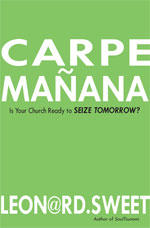
I just finished reading "Carpe Manana" by Leonard Sweet. Sweet is one of the "emerging" voices in the Emerging Church movement, and is thought by many to be the spokesperson for the future of evangelicalism in America. Sweet is an excellent communicator who points out what he sees as ways the church will have to change its methods in order to reach the postmodern generation in which we live.

You won't agree with everything Sweet writes or insinuates in this book. But this book illustrates that the church exists in a different world than the world our grandparents grew up in. Teenagers today have more power and information at their fingertips than the most learned scholars had access to a hundred years ago. My grandparents had to travel 30 miles to church, which started at 11:00am in order to give them time to milk the cattle before leaving the house. Today, I can listen to my choice of John MacArthur, Charles Swindoll, Chip Ingram, or a thousand other pastors while I'm milking my cattle if I wish.

Technology is still exploding rapidly. I'm only twenty-five, and when I was a teenager in order to spend time with my friends, we had to go to the mall, or meet at one of our houses. I would go door to door in my neighborhood to see who could come out and play. Today, I just have to login to AOL Instant Messenger, where I receive instant community with whomever else is logged in. The times, they are a changing.

Like I said, you'll disagree with some of what Sweet deems necessary steps in order for the church to Carpe Manana, "seize tomorrow." I certainly did. Sweet believes that the church needs to become more like the culture in order to attract and reach out to the culture. In a culture that values relative truth, moral obscurity, and a reliance on experience over intellect, the ramifications of such a change in the church's philosophy are downright scary. The entire hope of the evangelical church is based on absolute truth, moral law, and the fact that we will not experience the ultimate realization of our hope until after the clock stops ticking.

If the church attempts to reflect today's culture, it really won't be "seizing tomorrow" as Sweet's title indicates. Postmodernism is a passing trend, just as modernism, premodernism, and all other culture isms throughout history. To seize upon the postmodern culture would be to seize today. To truly seize tomorrow demands that we look beyond the postmodern culture to see where it is leading us.

The church doesn't need to be postmodern. The church must transcend secular culture. In fact much of the problem with today's church can be found in that it has decided to reflect secular culture rather than reflecting on that culture. If Peter, Paul, John, Apollos, Silas, and others had attempted to fit the church into the mold of their culture, the church would have died before it left Jerusalem. Why should our understanding of the relationship between church and the culture be any different from theirs?

Despite the differences I may have with Sweet's conclusion and its underlying philosophy, this book was a tremendously helpful read. Although the church should never become postmodern, it must understand postmodernism, and use that understanding to help its influence.

Use of the tools and technology given to us by a specific culture or trend does not indicate the church has identified completely with that movement. For example, my uncle the Pyromaniac disagrees vehemently with the postmodernization of the church, and is definitely not cool enough to be postmodern, although he keeps a blog - the ultimate public diary for the postmodern generation. The difference may seem subtle, but it is monumental.

It is important to recognize that it is completely possible for the church to use the tools of a culture without selling out wholesale to a change of identity that the proponents of the postmodernization of the church seem to want.

The biggest problem in the church today is not that the church is not becoming enough like the postmodern culture. Rather, the biggest problem in the church can be found in the mindset of those who want to model the church after secular culture instead of allowing the Gospel Message of Jesus Christ to affect life-change in individuals who will make an impact on their culture.

Media, Culture, and Godliness

My wife and I finished watching the first season of the hit TV show "24" on DVD last night. I became obsessed, yes I think that's the right word, with the show during the second season, and Kari joined me for season four after we got married. Neither of us had seen season one, so that was my birthday present this year.

Last night we had two hour-long episodes left, and only planned to watch one. But after the first episode ended, neither of us was planning to turn it off. (We both knew the other would sneak in to watch the final episode in the middle of the night).

In the next to last episode, presidential candidate David Palmer (played by Dennis Haysbert) is tempted to commit adultery by an attractive speech writer on his staff. She has been given permission to pursue the candidate, unbeknowst to him, by his wife who believes an affair would give her more control in the relationship. As we watched Palmer give the staffer a key to his private suite, and ask her to meet him there in a few minutes, I had no doubt as to what was coming. Palmer would give in to temptation, commit adultery, and find a way to cover it up.

He didn't. But that didn't keep the expectation I had from nagging me the rest of the evening. At what point did the entertainment industry switch to where the viewer automatically assumes characters will make the wrong moral choice?

And worse, why isn't the Christian community doing anything about it? I'm not talking about picketing, or boycotting. I'm talking about the fact that I watch secular programming and see good television. I watch "Christian" programming and see ladies with cotton candy hair, gaudy gold furnishings, and mullet-clad preachers in white suits "healing" women of their unmentionable problems.

The music industry isn't much better. Christian music is about 4 years behind secular music. Seriously. Britney, Christina, and Jessica came out about six years ago. Four years after they hit the scene, three or four (more modestly dressed) clones started making the charts on the Contemporary Christian Music world.

What is it about Christianity that causes us to react to the culture? What is it about conservatism that prevents us from being a trend setter, a light on a hill, rather than the little brother who wants to be a part of the game, but lacks the talent and ability to make it past the sideline?

Our churches don't need to be postmodern. We don't need to try to find ways to make ourselves more like the culture. (Wasn't that the sin of the Israelites when they demanded God give them a king so they could be more like the cultures that surrounded them?) The church needs to develop its identity apart from the culture, and allow the culture to come to it.

If our God is so great, why are we afraid to tell the world about Him and what He says? If He is the Creator God, why are we so afraid of reflecting that creativity through our own lives? If He created the universe out of nothing, why does Christ's Body feel the constant need to be like everyone else? We champion holiness, purity, love, justice, and righteousness as "godly characteristics" in ourselves (And rightly so). Why are we unwilling to reflect His creativity and proactivity in similar ways?

Take me out to the ballgame

There are few things better in this world than settling in to a stadium seat on a nice summer night. Hot dog in one hand, foam finger in the other hand, with an ice cold Dr. Pepper balanced precariously between my legs... life doesn't get much better than this.

I'm a baseball fanatic. Unfortunately, my team of choice is the Texas Rangers. (I'm also a Dallas Cowboys and Oklahoma State University die-hard, so I've learned how to lose gracefully). With the Rangers 13.5 games behind the Angels, I am thrilled to have the diversion that the Little League World Series provides.

The Little League World Series is real baseball. There are no contract negotiations, steroid scandals, or labor strikes in Little League. There are not endorsement deals. They don't receive celebrity status. They get a free baseball cap, and a chance to live their dreams with kids from all over the world on ESPN. These kids play hard, think hard, run hard, slide hard, throw hard, and hit hard, and they do it for the love of the game. And they leave it all on the field. This is a once in a lifetime opportunity, and they know it.

Wouldn't it be nice if Christians lived the Christian life the way these kids play baseball? One of the little league coaches told his pitcher yesterday, "Son, no guts, no glory." Isn't that the truth?

Every single day we live is a once in a lifetime opportunity. "Whatever your hand finds to do, do it with all your might; for there is no activity or planning or knowledge or wisdom in [the grave] where you are going" (Ecclesiastes 9:10). Play hard. Run hard. Leave everything you have on the playing field. Today is a once in a lifetime opportunity.

Roberston

FoxNews.com is currently running an article about Pat Roberston's comments concerning Venezuelan President Hugo Chavez. Roberston declared the time had come for American operatives to "take [Chavez] out."

Chavez has thought for some time that the United States is behind plots to assassinate him, and according to Roberston, the time has come to make those dreams a reality.

Frankly, I'm ashamed of Robertson, and am thankful that virtually no one watches his show apart from news reporters looking for a story. Aside from the fact that Robertson regularly puts his foot in his mouth, and makes nearly as many recantation speeches as regular speeches, he has taken a platform that could be used to reach millions with the Gospel and turned it into a hate-spewing circus act that rates right up in my book with Jerry Springer. And I mean that.

Democracy is a privelege, and a blessing from God. As such, Americans should see it as a stewardship entrusted to them, and should be involved in the workings of government to ensure that the government provides us and our children with a safe, secure, free place to live.
However, I don't see a command for political activism anywhere in Scripture. In fact, the vast majority of times that political activists are pictured in Scripture, it's in a negative light (see the Zealots, Pharisees, Sadducees, etc...). Instead, I see commands to "submit to governing authorities" (Romans 13:1), and promises that God holds the hearts of kings in the palm of his hand (Proverbs 21:1).

Christians have another citizenship above and beyond their citizenship in the United States. Our status as people who are "in Christ," (Ephesians 1) is a higher calling than our status as American citizens. Thus when then two conflict, we should defer to our higher calling. In Robertson's case, the two conflict. Calling for the assassination of world leaders from such a public platform is an embarrassment. Claiming that feminism "causes women to kill their children" is unbelievable.

It's time for Robertson to retire and begin working on his memoirs. Out of the public eye. His regular lapses in coherent thought have cast shame on the church in America, and has caused great damage to the ministries of legitimate spokespersons of Christianity who are attempting to make a genuine difference for Jesus Christ in the world.

I'm as patriotic as the next guy. I get chills every time the Air Force does a flyover at a baseball game. I bawl like a baby when I'm at a concert where a band plays the military hymns and asks the veterans to stand up. But I'm prouder to be a Christian. And every time someone like Pat Robertson stands up under the name of Christ, and spews complete polemic nonsense about something totally unrelated to the Gospel, I feel like I'm watching someone burn my flag. And it's time for that to stop.

Some glad morning...

Friday night, Kari and I met some friends for dinner in Fort Worth's "Sundance Square." We have a running date with these friends - two other married couples - who live in the Dallas/Fort Worth area. Each month, a different couple organizes the evening, and we have a night of fun and fellowship. Some of our prior outings have taken us to the home of one of the couples for desert, or to a concert, or a nice restaurant. They even persuaded me to go two-stepping. Once.

We ate a rather good Mexican food meal at Mi Cocina, and then decided to go to see Pete's Dueling Pianos. If they had taken the "bar" out of Pete's Piano Bar, this place would have been completely up my alley. I've never seen pianists as talented as the four men who played at Pete's on Friday.

The show would have received an "R" rating for some pretty rank humor and some foul language - something we weren't expecting when we walked in, and that the show wouldn't have missed had it been without. So I was surprised when one of the piano players walked out with his shirt gaping open, revealing a James Avery-style cross necklace hanging around his neck. I said a quick prayer that either no one else saw it, or that he wouldn't be party to the same jokes and language used by the prior two musicians.

The musicians spent the evening playing almost every (secular) sing along song you could think of. The crowd belted out "Piano Man," and "Crocodile Rock." We sang everything from "We are the Champions," to "God Bless the USA." But two songs into his set, the guy with the cross necklace completely floored me by beginning to belt out "I'll Fly Away." The experience was surreal. Here we were, sitting in a dingy bar with a bunch of inebriated college-aged students, singing a song our church sang in worship last Sunday. The song was followed up by Kenny Rogers' "You Picked a Fine Time to Leave Me Lucille," with an added part for the audience... Don't ask. (Suffice it to say, it ain't "I'll Fly Away")

I don't know if my jaw visibly hit the floor or not, but it was one of the most unusual experiences of my life. Here we were, surrounded by drunk college students, who were singing about a "home on God's celestial shore" with more exuberance than I've ever heard a church sing it.

At first, the experience put a damper on the evening. It kept nagging at me... These kids knew the words. Apparently, they stood next to their moms and dads in church growing up, and learned it like the rest of us. They'd been in Sunday School, or Youth Group, or Church Camp, and had sung this song as a part of a body who was singing it for the right reasons. Now, here they were, struggling to stand up, singing the same song again. What happened?

Today, I'm struck with the irony. I can say with relative certainty that absolutely none of the college students at Pete's Dueling Piano Bar showed up on Friday hoping to worship. In fact, one might probably guess that was the last thing on their mind. But there we were, and worship we did. They didn't know what happened. And virtually none of them was consciously singing testimonies about a hope we have in an unchanging God who has promised eternal life to those who place their trust in Him. But on Friday night, the same God who brought Himself glory through the testimony of an ass, (Numbers 22), and Who has the capability of causing inanimate objects to praise him (Luke 19:39-40), brought Himself glory through the testimony of a few hundred drunk college students.

Book Review: Why Churches Die

"Why Churches Die" is a book authored by Mac Brunson, pastor of First Baptist Church Dallas (TX), and Ergun Caner, dean of Liberty Baptist Theological Seminary. According to the subtitle, the goal of the book is to "diagnose lethal poisons in the Body of Christ." This book diagnoses 12 such poisons to the Body of Christ in a fashion that makes the book an easy read.

Brunson and Caner utilize fictitious case-studies to introduce each chapter, although nearly every reader will swear the authors visited their church once upon a time, only changing names to protect the guilty.

The authors of "Why Churches Die" are spot on in their identification of the symptoms of a dying church. They are, in my humble opinion, extremely weak in their use of biblical exegesis throughout the book. They have attempted to tie each symptom of a dying church to a biblical character who exemplifies that characteristic. In some cases, the examples fit. (For example, using Martha to describe the obsessive-compulsive tendency of some Christians to be distracted by the important while neglecting the essential) In other cases the examples used are, at best, a stretch (For example, pages 34-39 are devoted to explaining how Isaac's life decisions were all made because of a desire to coast on his father's past, a conclusion that is based on conjecture and speculation).

My other gripe about this book, though less substantial, is that the book spends the majority of each chapter pointing out the dangers of the various poisons to the church, and virtually no time diagnosing a solution. If a doctor tells me I'm dying, my immediate desire is not for information about the various permutations of the disease. I want to know how it can be treated.

Though I wouldn't give this book rave revues, it was a helpful reminder of just how delicate is the balance that must be maintained in Christ Body in order for it to remain healthy.

Ask the average churchgoer what the problem is with church today, and you're likely to hear a comment about the music. It's too loud, too soft, too modern, too out of touch. Or you'll hear about the use of technology, the absence of pews, or the length of the Pastor's sermon. But I've found with further questioning, those aren't the problems at all. There are "archaic" churches in America that God is using in marvelous ways, even in the 21st century. Likewise, there are "whippersnapper" churches that are making a global impact in the world for Jesus Christ. Style, format, and programming are the least of most congregants' concerns.

Despite the glaring negatives of the "postmodern" generation, what the church is faced with today is a culture that values authenticity, credibility, and character, more than the trappings of "religion." Today's culture wants content. They need the Gospel. And it's time for the dying churches of America to wake up and start talking about what really matters, instead of the things that have most recently consumed us.

Immunity for Benedict?

Associated Press

VATICAN CITY – Lawyers for Pope Benedict XVI have asked President Bush to declare the pontiff immune from liability in a lawsuit that accuses him of conspiring to cover up the molestation of three boys by a seminarian in Houston, court records show.

The Vatican's embassy in Washington sent a diplomatic memo to the State Department on May 20 requesting the U.S. government grant the pope immunity because he is a head of state, according to a May 26 motion submitted by the pope's lawyers in U.S. District Court for the Southern Division of Texas in Houston.

Joseph Ratzinger is named as a defendant in the lawsuit. Now Benedict XVI, he's accused of conspiring with the Archdiocese of Galveston-Houston to cover up the abuse during the mid-1990s. Three boys, identified in court documents as John Doe I, II and III, allege that a Colombian-born seminarian on assignment at St. Francis de Sales church in Houston, Juan Carlos Patino-Arango, molested them in the church in the mid-1990s. Mr. Patino-Arango has been indicted in a criminal case by a Harris County grand jury and is a fugitive from justice, the lawsuit says.

State Department spokeswoman Gerry Keener said Tuesday that the pope already is considered a head of state and has immunity. (End of News Story)

This news completely banishes any hope one might have had of seeing the reform so badly needed by the Roman Catholic Church; at least not under Benedict XVI's watch. The fact that this request was even brought to Washington hints that there is much more to the story than the Vatican wants released.

The Roman Catholic Church is in shambles. I had faint hopes that Ratzinger, because of his conservative, scholarly approach to his religion, might stumble across the ways in which Roman Catholic theology parted ways from its self-professed roots in Augustinian theology. But until the church deals with the sex-abuse issue, it's credibility will remain in the pits. And it should. A church who turns its head while its leaders take advantage of innocent members would is a complete disgrace to the name of Christianity.

Although most protestants would deny that the Roman Catholic Church is preaching the gospel revealed in Scripture, the fallen world system lumps the RCC, the protestant church, and the zany television evangelist in the same boat. There's no wonder the church has a credibility issue.

It's time for the Protestant Church to deal with its issues so that it can stand tall above the counterfeits. Here's one person praying for an authentic Christian Church that is proud to stand as transparent, authentic, real examples of Christ's Body at work on the earth.


Get the door...

"Knock, knock, knock."

"Geez, not again," I thought. I had been locked in my office for three hours hoping inspiration would hit. I was putting together my sermon for Sunday, and needed the perfect illustration to drive home my point. And I was close. Really close.

"Boom, Boom, Boom."

Whoever was at the door was persistent. They were afraid I hadn't heard them the first time. I had. I was toying with the idea of ignoring them, but the last time I did that I found out I had ignored a matrairch of the church who left her casserole dish in the kitchen and desperately needed it in order to entertain company that night. She had driven thirty miles to the church (uphill both ways), and couldn't figure out what I was possibly doing in there.

It wasn't about her, honestly. If I had been certain it was her, I would have been thrilled to answer the door. But I'm the only pastor who offices at the church, and never know who will be on the other side of the large glass doors when I come around the corner. Often it's a delivery man. Sometimes it's a church member, although most of them call before they come. But often, it's them.

Anyone who has spent time in a church office knows who "them" is before they read it. "Them" is the steady stream of people who stop by the church on a regular basis looking for assistance. They always have a story, and it's almost always the same. Their husband couldn't come because he's sick at home. They lost their job two months ago and are living in a hotel. They're down to their last and only need to keep their family off the street. Can I find it in my heart to help them out?

They couldn't do any better if they removed my heart from my chest, tied it in knots, and shoved it back in my chest. These people are good. They're believable. They're polite. They're contrite. And everything in me wants to give them whatever money I have to help them out. After all, their sick husband can't be put out on the street, can he?

But I've been burned before. I've seen these people leave the church, to see them thirty minutes later drinking their sick husband's "medicine" out of a brown paper sack. That hurts, because I know there are people in our culture with legitimate needs. There are people with spouses who are truly suffering, who are truly down on their luck, and who could truly be helped by the token amount I give them. But I can't tell the difference.

Our church gives money to Mission Arlington, who is designed to help these situations, and we send a lot of people there. But most return, having been turned down by Mission Arlington for one reason or another. That makes my decision easier, but still not easy.

In the past, I used to be haunted by James 2:15-17. "If a brother or sister is without clothing and in need of daily food, and one of you says to themn "Go in peace, be warmed and be filled," and yet you do not give them what is necessary for their body, what use is that?" Nobody wants to be a hypocrite, especially as a pastor. And I certainly don't want to tarnish the name of Christ because of my unwillingness to give money to someone who may or may not need it.

There's a part of me that even leaned toward giving money to people I doubted, in hopes that Christ might be magnified through my graciousness, and that these people might be drawn to Christ through my willingness to give. But that didn't work. These people have a network, and as soon as you help one of them, the line starts to grow outside the door. Then there's no money left for legitimate needs.

But not long ago, I started looking at James 2:15-17 again, and I have a new philosophy for dealing with my friends who are down on their luck.
Number one, I rarely answer the door. It's dangerous for me to be here by myself speaking to people I'm about to make mad. Number two, I try to listen graciously to their story, and ask as many questions as possible. Sometimes this is enough. When they find out I'm serious about understanding their story, some of them get up and leave. Number three, I only help out with food, shelter, or clothing. Period. James 2:15-17 doesn't say anything about gas to visit grandpa, or hotel stays, or anything of the sort. If I can get someone some bread and lunchmeat for a sandwich, or a coat for the winter, I'm happy to help out. But I don't do cash. I don't want to cause them to fall into temptation when they're standing in Tom Thumb trying to decide between baby formula and Jim Beam. Instead, I buy some $5 shopping cards for Walmart and Tom Thumb. I can distribute those as need be, and they don't work on liquor or cigarettes.

Finally, as they leave, I ask to pray for them. I share the Gospel with them. And I almost always tell them about how bad I've been burned in the past, and how I'm going to pray as they leave that if they're taking advantage of me, God would not allow them to look themselves in the mirror until they made things right with Him. That way, I get to be gracious, and a good steward of the finances over which I've been given care.

Just some ideas. But I should wrap them up... someone's knocking at the door.

Gaza Gaffe

In what could be considered a historic moment in the history of the Middle East peace process, Israel has begun an abandonment of the Gaza Strip. Jewish settlers in Gaza were served eviction notices today, and forced by Israel's military to abandon their homes. The settlers vowed to oppose the pullout using peaceful means, and had formed human chains attempting to protect their homes, according to Fox News. Meanwhile, Jewish men donned their white prayer shawls and prayed at the wall for divine intervention.

Unfortunately, the true sadness of Israel's pullout from Gaza does not come from seeing Jewish settlers being forced from their homes. The tragedy of this story is in the fact that the pullout of these thousands of Israelis will ultimately show to have been in vain when it comes to the overall quest for peace in the Middle East.

Land for peace has never worked, and will never work in the Israeli/Palestinian struggle. The struggle for Palestinian leadership is not about land; it's about the complete eradication of Israel from the world's population. Hamas, the Islamic militant organization is already proclaiming the pullout as a retreat by the Israelis, and is citing militant operations against the Israelis as the basis for the pullout. They don't recognize this as a step towards peace - they recognize the pullout as an indication that their terrorist actions have been fruitful. Israel is egging them on, not taking a step towards peace.

Granted, the rank and file Palestinian is not a bloodthirsty madman who dreams each night of the complete annihilation of Israel. But the leadership of the Palestinians is exactly that. And as long as that remains the case, Israel should take its bargaining chips off the table. Know when to hold 'em, and know when to fold 'em.

But Israelis everywhere are drinking the Koolaid. They see this as a sacrifice in order to protect Jerusalem. They're confident that when Palestinian leadership comes calling, and wants to make Jerusalem the Palestinian capital, they'll accept Gaza instead. Wrong. Palestinians are already chanting "Today Gaza, tomorrow Jerusalem."

As the old saying goes, "Fool me once, shame on you. Fool me twice, shame on me." Israel has been fooled too many times by empty promises of peace by the Palestinians. It won't work this time, and it won't work next time. (And there will be a next time). It's time for Israel to stop catering to terrorists, and bloodthirsty lunatics, and to stand its ground.


"Other?"

Last night I got the opportunity to talk to my good friend, U.S. Air Force Academy Cadet Ben Gardner. The title "cadet" is new as of yesterday. Previously he was "Basic Cadet Ben Gardner," which means that his life has been a living nightmare for the past several weeks. But beginning today he's on his way to becoming just like Maverick or Iceman from Top Gun. I tried to get him to go by the name "Goose," but he thought it would mean a few extra push-ups, not to mention that Goose dies in the end. It's okay, Goose is his dog's name anyway.

I've only had one chance to visit the Air Force Academy, which is known for its beauty as much as its status as one of the elite military academies in the world. The crowning jewel of the Academy is the chapel, which stands 150 feet high, and boasts 17 spires which point to the heavens. (I'm told the number of spires is insignificant. The architect decided on 17 because it was the most cost effective).

Inside the chapel, cadets can choose from one of five different worship spaces:

The Protestant Chapel is on the upper floor, accented with beautiful stained glass windows that draw the eye to a huge cross that is suspended from the ceiling.

The Catholic Chapel is in the south section of the ground floor. A large glass mosaic is its focal point, containing a ten-foot image of Mary, and one of the Angel Gabriel. The Holy Spirit appears in the mural as a dove. In front of the mural sits the altar, which holds a large crucifix.

The Jewish Chapel is designed as a circle within a square, which signifies the global mission of the USAF, and the overlasting presence of God. The foyer surrounding the synagogue portion of the Chapel is paved with stone imported from Jerusalem. The synagogue also boasts a copy of the Torah that was saved from Nazi destruction during World War II.

The chapel itself is gorgeous. The meticulous attention to detail and beauty in each chapel has made the USAF chapel a tourist attraction for many who travel through Colorado Springs. But the most interesting part of the chapel barely makes the tour. There are two other rooms in the Chapel, that would go unnoticed by the average tourist who didn't know they existed. That's right, in the extravagantly decorated, meticulously detailed USAF Academy Chapel, there are two rooms in the basement with no decorations, no symbolism, and virtually no beauty. They're simply marked "Other." Cadets who worship in the "Other" rooms can check out religious accessories for their belief system at the front desk.

I guess a part of me is amazed at the bravery of a person who will worship in a room titled "Other." Another part of me is, of course, saddened. But to me what's worse than a cadet who chooses to worship in a room marked "Other," is the people all across the world who worship the god named "Other" and don't even realize it.

It seems particularly rampant in America. We go to churches where "Jesus is our homeboy," or where we're determined to "Git 'er done for God," but where the God of the Bible is rarely mentioned, much less worshipped and revered. Instead, we've put God in a box where we want Him, and by the time we're done wrapping Him up, He's a different god altogether. When god ceases to be worshipped as God, we might as well worship in the "Other" room. Unfortunately, that's what many of today's churches should be relabeled, and yet they don't even know it.

Holiness or Happiness?

Kari has been reading "The Sacred Marriage" for a class she is taking at DTS this fall. It was laying on the coffee table last night as I walked by, and something about the subtitle struck me.

I was awake most of the night last night because I hurt my shoulder last night playing softball and couldn't ever get positioned right in the bed. And Gary Thomas's (or his publisher's) words kept coming into my mind.

"What if God designed marriage to make us holy more than to make us happy?"

I love that. Now, don't misunderstand, I am very happy in my marriage. Kari and I have a great relationship. I married up - God has blessed me with an amazing wife, which I don't take for granted. But I think Gary Thomas is on to something, and I love the way he puts it.

Most couples cite "irreconcilable differences" as the cause of their marriage breakup, which seems to be code language for "I'm just not happy anymore." It seems as though if I had a dollar for the number of times I had heard people excuse their divorce by saying "I'm just not happy anymore," I could retire to a private island in the Caribbean tomorrow. Marriage cannot just be about happiness, an emotion which changes from day to day.

This isn't to suggest that God doesn't intend our marriages to be happy - certainly He does. But it seems our culture in general has faulty expectations when it comes to marriage, and that those faulty expectations are leading to faulty marriages. Happiness cannot be the end in and of itself in marriage or in life.

The overarching will of God for our life is holiness (1 Thessalonians 4:1-3, 1 Peter 1:15), not specifically our happiness. Holiness will sometimes bring earthly happiness, and will certainly produce eternal happiness, but it's holiness that is the goal in everything. Gary Thomas's subtitle may sound trite, or like a meaningless, cute saying, but make no mistake: The difference between living toward a goal of achieving my maximum happiness, or of achieving Christ's maximum glory is night and day.

Trading My Sorrows

Trading My Sorrows
Darrell Evans
I'm trading my sorrows,
I'm trading my shame
I'm laying them down
For the joy of the Lord

I'm trading my sickness, I'm trading my pain
I'm laying them down, For the joy of the Lord

Yes, Lord

I'm pressed but not crushed,
Persecuted not abandoned
Struck down but not destroyed.
I am blessed beyond the curse
For his promise will endure,
That his joy is going to be my strength
Though my sorrows may last for the night,
His joy comes with the morning
As a worship leader, I didn't program this song for years after it came out, because I completely missed the point. On first read the song seems to contain a "prosperity gospel" message, that if you truly put your faith in Christ, you'll never have any problems, sickness, pain, sorrow, or struggle. Although this "prosperity message" is gaining popularity, it doesn't stand the test of Scripture. The world hates followers of Jesus Christ (John 15:18) and will persecute them for keeping His Word (15:20). Jesus promised His disciples "In the world you have tribulation..." (John 16:33).

But Darrell Evans' song isn't denying the first part of John 16:33. It's reminding the Christian that our hope is in the second half of the verse. "Take heart. I have overcome the world." The point of Jesus' comment, and my understanding of "Trading My Sorrows," is about attitude. When we face sorrow, sickness, shame, or pain, we have a choice. We can live life "under the circumstances," and spend our time griping, complaining, and feeling sorry for ourselves, or we can focus our minds on the promise of John 16:33 that Jesus has overcome the world.

I hate broccoli with the white hot intensity of a thousand flames. I'll always wonder why God created broccoli, and beyond that, why He made it healthy. But, I've found I can choke broccoli down if I have a Dr. Pepper in my hand. I hate broccoli, but I love Dr. Pepper. And I've found that if I chew up and swallow a piece of broccoli, and then take a quick chug of Dr. Pepper, the Dr. Pepper quickly washes away the disgusting taste in my mouth that the broccoli left. The knowledge that Dr. Pepper is coming makes the broccoli bearable.

That's the point of the song. In this world, you will have broccoli. But why focus on the broccoli when Dr. Pepper is right around the corner?